Want to post a buying lead? If you are not a member yet, please select the specific/related part number first and then fill the quantity and your contact details in the "Request for Quotation Form" on the left, and then click "Send RFQ".Your buying lead can then be posted, and the reliable suppliers will quote via our online message system or other channels soon.
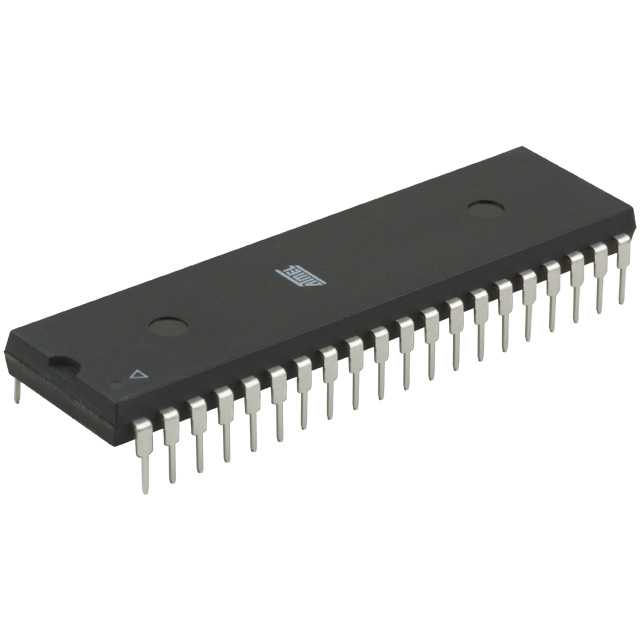
The ATmega161 is a low-power CMOS 8-bit microcontroller based on the AVR RISC architecture. By executing powerful instructions in a single clock cycle, the ATmega161 achieves throughputs approaching 1 MIPS per MHz allowing the sys-tem designer to optimize power consumption versus processing speed.The AVR core combines a rich instruction set with 32 general purpose working registers. All the 32 registers are directly connected to the Arithmetic Logic Unit (ALU),allowing two independent registers to be accessed in one single instruction executed in one clock cycle. The resulting architecture is more code efficient while achieving throughputs up to ten times faster than conventional CISC microcontrollers.
The ATmega161 provides the following features: 16K bytes of In-System- or Self-programmable Flash, 512 bytes EEPROM, 1K bytes SRAM, 35 general purpose I/O lines, 32 general purpose working registers, Real Time Counter, three flexible timer/counters with compare modes, internal and external interrupts, two programmable serial UARTs, programma-ble Watchdog Timer with internal oscillator, an SPI serial port and three software selectable power saving modes. The Idle mode stops the CPU while allowing the SRAM, timer/counters, SPI port and interrupt system to continue functioning. The power-down mode saves the register and SRAM contents but freezes the oscillator, disabling all other chip functions until the next external interrupt or hardware reset. In Power Save mode, the timer oscillator continues to run, allowing the user to maintain a timer base while the rest of the device is sleeping.
The device is manufactured using Atmel's high density nonvolatile memory technology. The on-chip Flash program mem-ory can be reprogrammed using the self-programming capability through the bootblock, using an ISP through the SPI-port,or by using a conventional nonvolatile memory programmer. By combining an enhanced RISC 8-bit CPU with In-System Programmable Flash on a monolithic chip, the Atmel ATmega161 is a powerful microcontroller that provides a highly flexible and cost effective solution to many embedded control applications.
The ATmega161 AVR is supported with a full suite of program and system development tools including: C compilers,macro assemblers, program debugger/simulators, in-circuit emulators, and evaluation kits.
ATMEGA161L Features
• High-performance, Low-power AVR® 8-bit Microcontroller • Advanced RISC Architecture 130 Powerful Instructions - Most Single Clock Cycle Execution 32 x 8 General Purpose Working Registers Fully Static Operation Up to 8 MIPS Throughput at 8 MHz On-chip 2-cycle Multiplier • Program and Data Memories 16K Bytes of Nonvolatile In-System Programmable Flash Endurance: 1,000 Write/Erase Cycles Optional Boot Code Memory with Independent Lock Bits Self-programming of Program and Data Memories 512 Bytes Nonvolatile In-System Programmable EEPROM Endurance: 100,000 Write/Erase Cycles 1K Bytes Internal SRAM Programming Lock for Software Security • Peripheral Features Two 8-bit Timer/Counters with Separate Prescaler and PWM Expanded 16-bit Timer/Counter System with Separate Prescaler, Compare, Capture Modes and Dual 8-, 9- or 10-bit PWM Dual Programmable Serial UARTs Master/Slave SPI Serial Interface Real Time Counter with Separate Oscillator Programmable Watchdog Timer with Separate On-chip Oscillator On-chip Analog Comparator • Special Microcontroller Features Power-on Reset and Programmable Brown-out Detection External and Internal Interrupt Sources Three Sleep Modes: Idle, Power Save and Power-down • I/O and Packages 35 Programmable I/O Lines 40-pin PDIP, 44-pin PLCC and TQFP • Operating Voltages 2.7V - 5.5V (ATmega161L), 4.0V - 5.5V (ATmega161) • Speed Grades 0 - 4 MHz (ATmega161L), 0 - 8 MHz (ATmega161) • Commercial and Industrial Temperature Ranges