Features: 19 ns Instruction Cycle Time from 26.32 MHz Crystal @ 3.3 Volts
52 MIPS Sustained Performance
Single-Cycle Instruction Execution
Single-Cycle Context Switch
3-Bus Architecture Allows Dual Operand Fetches in Every Instruction Cycle
Multifunction Instructions
Power-Down Mode Featuring Low CMOS Standby
Power Dissipation with 300 Cycle Recovery from Power-Down Condition
Low Power Dissipation in Idle ModePinout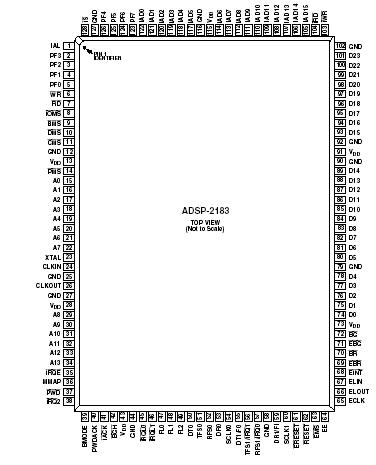 SpecificationsSupply Voltage . . . . . . . . . . . . . . . . . . . . . . . 0.3 V to +4.6 V
Input Voltage . . . . . . . . . . . . . . . . . . . . 0.5 V to VDD + 0.5 V
Output Voltage Swing . . . . . . . . . . . . . .0.5 V to VDD + 0.5 V
Operating Temperature Range (Ambient) . .40°C to +85°C
Storage Temperature Range . . . . . . . . . ..65°C to +150°C
Lead Temperature (5 sec) LQFP . . . . . . . . . . . . . . ... +280°CDescriptionThe ADSP-2183 is a single-chip microcomputer optimized for digital signal processing (DSP) and other high speed numeric processing applications.
The ADSP-2183 combines the ADSP-2100 family base architecture (three computational units, data address generators and a program sequencer) with two serial ports, a 16-bit internal DMA port, a byte DMA port, a programmable timer, Flag I/O, extensive interrupt capabilities, and on-chip program and data memory.
The ADSP-2183 integrates 80K bytes of on-chip memory configured as 16K words (24-bit) of program RAM, and 16K words (16-bit) of data RAM. Power-down circuitry is also provided to meet the low power needs of battery operated portable equipment. The ADSP-2183 is available in 128-lead LQFP, and 144-Ball Mini-BGA packages.
In addition, the ADSP-2183 supports new instructions, which include bit manipulations-bit set, bit clear, bit toggle, bit test- new ALU constants, new multiplication instruction (x squared), biased rounding, result free ALU operations, I/O memory transfers and global interrupt masking, for increased flexibility.
Fabricated in a high speed, double metal, low power, CMOS process, the ADSP-2183 operates with a 19 ns instruction cycle time. Every instruction can execute in a single processor cycle.
The ADSP-2183's flexible architecture and comprehensive instruction set allow the processor to perform multiple operations in parallel. In one processor cycle:
• Generate the next program address
• Fetch the next instruction
• Perform one or two data moves
• Update one or two data address pointers
• Perform a computational operation

 ADSP-2183 Data Sheet