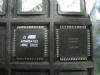
ATmega8 Features
• High-performance, Low-power AVR® 8-bit Microcontroller
• Advanced RISC Architecture
130 Powerful Instructions Most Single-clock Cycle Execution
32 x 8 General Purpose Working Registers
Fully Static Operation
Up to 16 MIPS Throughput at 16 MHz
On-chip 2-cycle Multiplier
• Nonvolatile Program and Data Memories
8K Bytes of In-System Self-Programmable Flash Endurance: 10,000 Write/Erase Cycles
Optional Boot Code Section with Independent Lock Bits In-System Programming by On-chip Boot Program True Read-While-Write Operation
512 Bytes EEPROM Endurance: 100,000 Write/Erase Cycles
1K Byte Internal SRAM
Programming Lock for Software Security
• Peripheral Features
Two 8-bit Timer/Counters with Separate Prescaler, one Compare Mode
One 16-bit Timer/Counter with Separate Prescaler, Compare Mode, and Capture Mode
Real Time Counter with Separate Oscillator
Three PWM Channels
8-channel ADC in TQFP and MLF package Six Channels 10-bit Accuracy Two Channels 8-bit Accuracy
6-channel ADC in PDIP package Four Channels 10-bit Accuracy Two Channels 8-bit Accuracy
Byte-oriented Two-wire Serial Interface
Programmable Serial USART
Master/Slave SPI Serial Interface
Programmable Watchdog Timer with Separate On-chip Oscillator
On-chip Analog Comparator
• Special Microcontroller Features
Power-on Reset and Programmable Brown-out Detection
Internal Calibrated RC Oscillator
External and Internal Interrupt Sources
Five Sleep Modes: Idle, ADC Noise Reduction, Power-save, Power-down, and Standby
• I/O and Packages
23 Programmable I/O Lines
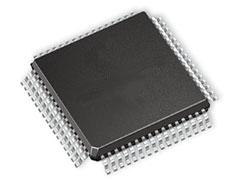
28-lead PDIP, 32-lead TQFP, and 32-pad MLF
• Operating Voltages
2.7 - 5.5V (ATmega8L)
4.5 - 5.5V (ATmega8)
• Speed Grades
0 - 8 MHz (ATmega8L)
0 - 16 MHz (ATmega8)
• Power Consumption at 4 Mhz, 3V, 25°C
Active: 3.6 mA
Idle Mode: 1.0 mA
Power-down Mode: 0.5 µA
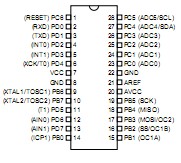
ATmega8 Connection Diagram
Map list: ABCDEFGHIJKLMNOPQRSTUVWXYZ 0123456789All