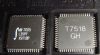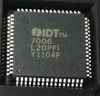
Features: • Typical tSK(o) (Output Skew) < 250ps• ESD > 2000V per MIL-STD-883, Method 3015; > 200V using machine model (C = 200pF, R = 0)• VCC = 3.3V ± 0.3V, Normal Range• VCC = 2.7V to 3.6V, Extended Range• CMOS power levels (0.4 W typ. static)• All in...
IDT74LVC162245A: Features: • Typical tSK(o) (Output Skew) < 250ps• ESD > 2000V per MIL-STD-883, Method 3015; > 200V using machine model (C = 200pF, R = 0)• VCC = 3.3V ± 0.3V, Normal Range&...
SeekIC Buyer Protection PLUS - newly updated for 2013!
268 Transactions
All payment methods are secure and covered by SeekIC Buyer Protection PLUS.

|
Symbol |
Description |
Max |
Unit |
|
VTERM(2) |
Terminal Voltage with Respect to GND |
0.5 to +6.5 |
V |
|
VTERM(3) |
Terminal Voltage with Respect to GND |
0.5 to +6.5 |
V |
|
TSTG |
Storage Temperature |
65 to +150 |
°C |
|
IOUT |
DC Output Current |
50 to +50 |
mA |
|
IIK IOK |
Continuous Clamp Current, VI < 0 or VO < 0 |
50 |
mA |
|
ICC ISS |
Continuous Current through each VCC or GND |
±100 |
mA |
This 16-bit transceiver is built using advanced dual metal CMOS technology. The LVC162245A is designed for asynchronous communication between data buses. The control-function implementation minimizes external timing requirements. IDT74LVC162245A can be used as two 8-bit transceivers or one 16-bit transceiver. IDT74LVC162245A allows data transmission from the A bus to the B bus or from the B bus to the A bus, depending on the logic level at the direction-control (DIR) input. The output-enable (OE) input IDT74LVC162245A can be used to disable the device so that the buses are effectively isolated. To ensure the high-impedance state during power up or power down, OE should be tied to VCC through a pullup resistor; the minimum value of the resistor is determined by the current-sinking capability of the driver. All pins of IDT74LVC162245A can be driven from either 3.3V or 5V devices. This feature allows the use of this device as a translator in a mixed 3.3V/5V supply system. The LVC162245A has series resistors in the device output structure of the "A" port which will significantly reduce line noise when used with light loads. The driver has been designed to drive ±12mA at the designated threshold levels. The "B" port has a ±24mA driver.