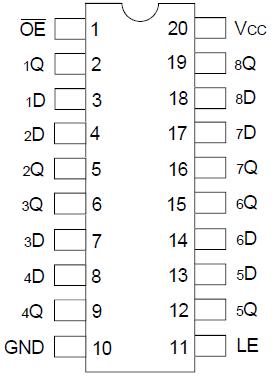
Features: • 0.5 MICRON CMOS Technology• ESD > 2000V per MIL-STD-883, Method 3015; > 200V using machine model (C = 200pF, R = 0)• VCC = 3.3V ± 0.3V, Normal Range• VCC = 2.7V to 3.6V, Extended Range• CMOS power levels (0.4 W typ. static)• Rail-to-rail output...
IDT74LVC373A: Features: • 0.5 MICRON CMOS Technology• ESD > 2000V per MIL-STD-883, Method 3015; > 200V using machine model (C = 200pF, R = 0)• VCC = 3.3V ± 0.3V, Normal Range• VCC = ...
SeekIC Buyer Protection PLUS - newly updated for 2013!
268 Transactions
All payment methods are secure and covered by SeekIC Buyer Protection PLUS.

|
Symbol |
Description |
Max |
Unit |
|
VTERM |
Terminal Voltage with Respect to GND |
0.5 to +6.5 |
V |
|
TSTG |
Storage Temperature |
65 to +150 |
°C |
|
IOUT |
DC Output Current |
50 to +50 |
mA |
|
IIK IOK |
Continuous Clamp Current, VI < 0 or VO < 0 |
50 |
mA |
|
ICC ISS |
Continuous Current through each VCC or GND |
±100 |
mA |
NOTE:
1. Stresses greater than those listed under ABSOLUTE MAXIMUM RATINGS may cause permanent damage to the device. This is a stress rating only and functional operation of the device at these or any other conditions above those indicated in the operational sections of this specification is not implied. Exposure to absolute maximum rating conditions for extended periods may affect reliability.
The IDT74LVC373A Octal transparent D-type latch is built using advanced dual metal CMOS technology.
While the latch-enable (LE) input is high, the Q outputs follow the data (D) inputs. When LE is taken low, the Q outputs are latched at the logic levels set up at the D inputs.
A buffered output-enable (OE) input of the IDT74LVC373A can be used to place the eight outputs in either a normal logic state (high or low logic levels) or a high-impedance state. In the high- impedance state, the outputs neither load nor drive the bus lines significantly. The high-impedance state and increased drive provide the capability to drive bus lines without interface or pullup components.
OE does not affect the internal operations of the latch. Old data can be retained or new data can be entered while the outputs are in the highimpedance state.
To ensure the high-impedance state during power up or power down, OE should be tied to VCC through a pullup resistor; the minimum value of the resistor is determined by the current-sinking capability of the driver.
Inputs of the IDT74LVC373A can be driven from either 3.3V or 5V devices. This feature allows the use of this device as a translator in a mixed 3.3V/5V system environment.