LC737212 General Description
LC737212 Features
• Fabrication in a CMOS process that allows these circuits to be directly operated from a telephone line
• Support for single-contact keypads
• Built-in oscillator circuit (fosc = 3.58 MHz) that can drive either a standard color-TV crystal oscillator element or a
ceramic resonator
• High-precision DTMF signal
• Frequency generator circuit (±0.1%) adopted for eased ceramic resonator selection
• Five one-touch 16-digit auto-dial memories and 20 quick-dialing memories
• On-hook or off-hook can be specified for memory entries.
• Mode change and pause data items can be stored in the dialing memories.
• 63-digit redial memory
• Automatic pause (3.9 seconds) insertion when the mode is switched.
• Automatic pause (1.0 second) insertion after a flash operation.
• Mode changing is one-directional, from pulse mode to tone mode.
• Output of a key press tone (1036 Hz, 31 ms) for keys other than DTMF keys when key input is valid
• Output of an operation complete confirmation tone (2072 Hz, 279 ms for each telephone number) when a telephone
number is stored in memory
• Generates 12 signal types in DTMF mode.
• Supports an on-hook dialing mode.
• Supports a hold function with hold mode.
• Supports both 10 and 20 pps dialing pulse rates.
• The mode can be switched from either the P/T pin or by a key input.
• Settable dialing pulse circuit closed ratio (make percent): either 33% or 39%.
• Supports either keypad or serial input.
• Provides serial output of the keypad input data and the internal status.
• Capable of controlling the serial output timing.
• Supports 18 user-defined keys.
• Wide operating power-supply voltage range
- Pulse mode: VDD = 1.5 to 5.5 V
- DTMF mode: VDD = 2.0 to 5.5 V
• Low power operation
- Pulse mode: IDD = 0.5 mA max (VDD = 3.0 V)
- DTMF mode: IDD = 1.0 mA max (VDD = 3.0 V)
• Low standby current
- IDR = 0.5 A max (VDD = 1.0 V)
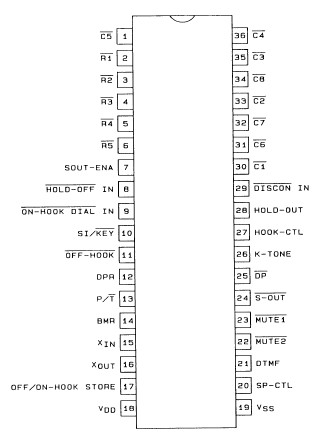
LC737212 Connection Diagram
Map list: ABCDEFGHIJKLMNOPQRSTUVWXYZ 0123456789All