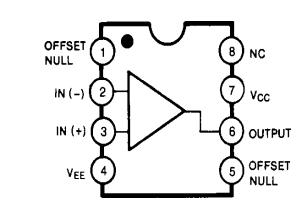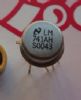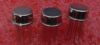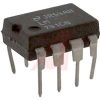
The LM741 series are general purpose operational amplifi-ers. It is intended for a wide range of analog applications.
The high gain and wide range of operating voltage provide superior performance in intergrator, summing amplifier, and general feedback applications.
| Parameter | Symbol | Value | Unit |
| Supply Voltage | VCC | ±18 | V |
| Differential Input Voltage | VI(DIFF) | 30 | V |
| Input Voltage | VI | ±15 | V |
| Output Short Circuit Duration | - | Indefinite | - |
| Power Dissipation | PD | 500 |
mW |
| Operating Temperature Range LM741C LM741I |
TOPR | 0 ~ + 70 -40 ~ +85 |
°C |
| Storage Temperature Range | TSTG | -65 ~ + 150 | °C |
•Short circuit protection
•Excellent temperature stability
•High Input voltage range
•Null of offset
Modulates existing house wiring with high-frequency signals that can bedetected by special receivers plugged into any AC outlet, for control of appliances by home computer. Applications include turning house lights on and off during owner's absence on elaborate time schedule programmed into computer. IC1 converts 8-bit data word from computer to proportional analog output current. This is converted to voltage by IC2 for control of VCO IC3 that gives frequency proportional to voltage. With values shown, range is about 30 to 110 kHz, with 256 discrete increments of frequency. Thus, input code 00000000 gives 30 kHz, 00000001 gives 30.3 kHz, and 01000000 (decimal 64} gives 49.2 kHz. Signal is applied to house wiring by 0.5-W power amplifier Q1-Q3, using optical coupling through IC4 to prevent computer circuit from interacting with house wiring. Supply voltage ±V is 11 to 13 V. T1 is 12.6-VAC 300-mA filament transformer. ICS is 2 to 2.5 V reference chip such as MC1403U. System uses one frequency to turn receiver on and frequency 4 kHz above or below in 8-kHz band to turn it off, for maximum of ten control channels in system. Article covers calibration of transmitter.-S. Ciarcia, Tune in and Turn on, Part 1:A Computerized Wireless AC Control System, BYTE, April 1978, p 114-116, 118, 120, and 122-125 (Part 2-May 1978, p97-100 and 102).