Features: ` High-performance, EEPROM-based programmable logic devices (PLDs) based on second-generation MAX® architecture
` 5.0-V in-system programmability (ISP) through the built-in IEEE Std. 1149.1 Joint Test Action Group (JTAG) interface available in MAX 7000S devices
ISP circuitry compatible with IEEE Std. 1532
` Includes 5.0-V MAX 7000 devices and 5.0-V ISP-based MAX 7000S devices
` Built-in JTAG boundary-scan test (BST) circuitry in MAX 7000S devices with 128 or more macrocells
` Complete EPLD family with logic densities ranging from 600 to 5,000 usable gates (see Tables 1 and 2)
` 5-ns pin-to-pin logic delays with up to 175.4-MHz counter frequencies (including interconnect)
` PCI-compliant devices availablePinout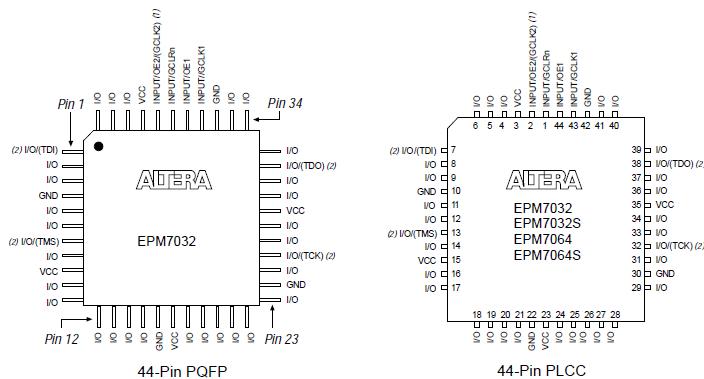 Specifications
|
Symbol |
Parameter |
Conditions |
Min |
Max |
Unit |
|
VCC |
Supply voltage |
With respect to ground (2) |
-0.5 |
4.6 |
V |
|
VI |
DC input voltage |
-2.0 |
5.75 |
V |
|
IOUT |
DC output current, per pin |
|
-25 |
25 |
mA |
|
TSTG |
Storage temperature |
No bias |
-65 |
150 |
|
|
TABM |
Ambient temperature |
Under bias |
-65 |
135 |
|
|
TJ |
Junction temperature |
Ceramic packages, under bias |
|
150 |
|
| PQFP and RQFP packages, under bias |
|
130 |
|
DescriptionThe MAX 7000 family of high-density, high-performance PLDs is based on Altera's second-generation MAX architecture. Fabricated with advanced CMOS technology, the EEPROM-based MAX 7000 family provides 600 to 5,000 usable gates, ISP, pin-to-pin delays as fast as 5 ns, and counter speeds of up to 175.4 MHz. MAX 7000S devices in the -5, -6, -7, and -10 speed grades as well as MAX 7000 and MAX 7000E devices in -5, -6, -7, -10P, and -12P speed grades comply with the PCI Special Interest Group (PCI SIG) PCI Local Bus Specification, Revision 2.2.
The MAX 7000E devices-including the EPM7128E, EPM7160E, EPM7192E, and EPM7256E devices-have several enhanced features: additional global clocking, additional output enable controls, enhanced interconnect resources, fast input registers, and a programmable slew rate.
In-system programmable MAX 7000 devices-called MAX 7000S devices-include the EPM7032S, EPM7064S, EPM7128S, EPM7160S, EPM7192S, and EPM7256S devices. The devices have the enhanced features of MAX 7000E devices as well as JTAG BST circuitry in devices with 128 or more macrocells, ISP, and an open-drain output option.
The MAX 7000 architecture supports 100% TTL emulation and high-density integration of SSI, MSI, and LSI logic functions. It architecture easily integrates multiple devices ranging from PALs, GALs, and 22V10s to MACH and pLSI devices. MAX 7000 devices are available in a wide range of packages, including PLCC, PGA, PQFP, RQFP, and TQFP packages.
The devices use CMOS EEPROM cells to implement logic functions. The user-configurable MAX 7000 architecture accommodates a variety of independent combinatorial and sequential logic functions. The devices can be reprogrammed for quick and efficient iterations during design development and debug cycles, and can be programmed and erased up to 100 times.
The devices contain from 32 to 256 macrocells that are combined into groups of 16 macrocells, called logic array blocks (LABs). Each macrocell has a programmable-AND/fixed-OR array and a configurable register with independently programmable clock, clock enable, clear, and preset functions. To build complex logic functions, each macrocell can be supplemented with both shareable expander product terms and highspeed parallel expander product terms to provide up to 32 product terms per macrocell.
The MAX 7000 family provides programmable speed/power optimization. Speed-critical portions of a design can run at high speed/full power, while the remaining portions run at reduced speed/low power. This speed/power optimization feature enables the designer to configure one or more macrocells to operate at 50% or lower power while adding only a nominal timing delay. MAX 7000E and MAX 7000S devices also provide an option that reduces the slew rate of the output buffers, minimizing noise transients when non-speed-critical signals are switching. The output drivers of all MAX 7000 devices (except 44-pin devices) can be set for either 3.3-V or 5.0-V operation, allowing the devices to be used in mixed-voltage systems.
The MAX 7000 family is supported byAltera development systems, which are integrated packages that offer schematic, text-including VHDL, Verilog HDL, and the Altera Hardware Description Language (AHDL)- and waveform design entry, compilation and logic synthesis, simulation and timing analysis, and device programming. The software provides EDIF 2 0 0 and 3 0 0, LPM, VHDL, Verilog HDL, and other interfaces for additional design entry and simulation support from other industrystandard PC- and UNIX-workstation-based EDA tools. The software runs on Windows-based PCs, as well as Sun SPARCstation, and HP 9000 Series 700/800 workstations

 MAX 7000 Data Sheet