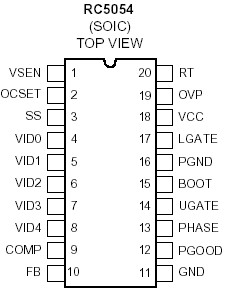
Features: • Drives Two N -Channel MOSFETs• Operates from +5V Power Input• Simple Single -Loop Control Design - Voltage -Mode PWM Control• Fast Transient Response - High -Bandwidth Error Amplifier - Full 0% to 100% Duty Ratio• Excellent Output Voltage Regulation•...
RC5054A: Features: • Drives Two N -Channel MOSFETs• Operates from +5V Power Input• Simple Single -Loop Control Design - Voltage -Mode PWM Control• Fast Transient Response - High -Band...
SeekIC Buyer Protection PLUS - newly updated for 2013!
268 Transactions
All payment methods are secure and covered by SeekIC Buyer Protection PLUS.

| Min. | Max. | |
| Power Input Voltage, VIN | 6V | |
| Supply Voltage, VCC | +13.5V | |
| Boot Voltage, VBOOT - VPHASE | +13.5V | |
| VCC or I/O Voltage | GND -0.3V | VCC + 0.3V |
| ESD Classification | Class 2 |
The RC5054A provides complete control and protection for a DC-DC converter optimized for high-performance microprocessor applications. It is designed to drive two N-Channel MOSFETs in a synchronous-rectified buck topology. The RC5054A integrates all of the control, output adjustment, monitoring and protection functions into a single package.
The output voltage of the converter is easily adjusted and precisely regulated. The RC5054A includes a 5-input digitalto- analog converter (DAC) that adjusts the output voltage from 2.1V DC to 3.5VDC in 0.1V increments and from 1.3VDC to 2.1VDC in 0.05V steps.
The RC5054A provides simple, single feedback loop, volt- age-mode control with fast transient response. It includes a 200KHz free-running triangle-wave oscillator that is adjustable from 50KHz to 1MHz. The error amplifier features a 15MHz gain-bandwidth product and 6V/s slew rate which enables high converter bandwidth for fast transient performance. The resulting PWM duty ratio ranges from 0% to 100%.
The RC5054A monitors the output voltage with a window comparator that tracks the DAC output and issues a Power Good signal when the output is within ±10%. The RC5054A protects against over-current conditions by inhibiting PWM operation. Built-in over-voltage protection triggers an external SCR to crowbar the input supply. It monitors the current by using the RDS(ON) of the upper MOSFET which eliminates the need for a current sensing resistor.