Features: · Qualification in Accordance With AEC-Q100†
·Qualified for Automotive Applications
· Customer-Specific Configuration Control Can Be Supported Along With Major-Change Approval
· ESD Protection Exceeds 2000 V Per MIL-STD-883, Method 3015; Exceeds 200 V Using Machine Model (C = 200 pF, R = 0)
· Operates With a 3.3-V Supply
· Low Power Replacement for the PCA82C250 Footprint
· Bus/Pin ESD Protection Exceeds 15-kV HBM
· Controlled Driver Output Transition Times for Improved Signal Quality on the SN65HVD230Q and SN65HVD231Q
· Unpowered Node Does Not Disturb the Bus
· Compatible With the Requirements of the ISO 11898 Standard
· Low-Current SN65HVD230Q Standby Mode 370 µA Typical
· Low-Current SN65HVD231Q Sleep Mode 0.1 µA Typical
· Designed for Signaling Rates‡ Up To 1 Megabit/Second (Mbps)
· Thermal Shutdown Protection
· Open-Circuit Fail-Safe DesignPinout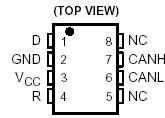 SpecificationsSupply voltage range, VCC . . . . . . . . . . . . . . . . . . . . . . . . . . . . . . . . . . . . . . .0.3 V to 6 V
Voltage range at any bus terminal (CANH or CANL) . . . . . . . . . . . . . . . . . . . . .7 V to 16 V
Voltage input range, transient pulse, CANH and CANL,
through 100 Ω (see Figure 7) . . . . . . . . . . . . . . . . . . . . . . . . . . . . . . . . . . .. 25 V to 25 V
Input voltage range, VI (D or R) 0.5 V to VCC . . . . . . . . . . . . . . . . . . . . . . .. . . . . .+ 0.5 V
Electrostatic discharge: Human body model
(see Note 2) CANH, CANL and GND . . . . . . . . . . . . . . . . . . . . . . . . . . . . . . . . . . . . . . .15 kV
All pins . . . . . . . . . . . . . . . . . . . . . . . . . . . . . . . . . . . . . . . . . .2.5 kV
Charged-device model (see Note 3) All pins. . . . . . . . . . . . . . . . . . . . . . . . . . . . . . . . . . 4 kV
Continuous total power dissipation. . . . . . . . . . . . . . .. . . . . . . See Dissipation Rating table
Storage temperature range, Tstg . . . . . . . . . . . . . . . . . . . . . . . . . . . . . . .65°C to 150°C
Lead temperature 1,6 mm (1/16 inch) from case for 10 seconds. . . . . . . . . . . . . . . . 260°C
1. All voltage values, except differential I/O bus voltages, are with respect to network ground terminal.
2. Tested in accordance with JEDEC Standard 22, Test Method A114-A.
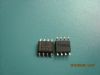
3. Tested in accordance with JEDEC Standard 22, Test Method C101.DescriptionThe SN65HVD230Q, SN65HVD231Q, and SN65HVD232Q controller area network (CAN) transceivers are designed for use with the Texas Instruments TMS320Lx240x 3.3-V DSPs with CAN controllers, or with equivalent devices. SN65HVD230Q, SN65HVD231Q, and SN65HVD232Q are intended for use in applications employing the CAN serial communication physical layer in accordance with the ISO 11898 standard. Each CAN transceiver is designed to provide differential transmit capability to the bus and differential receive capability to a CAN controller at speeds up to 1 Mbps.
Designed for operation in especially-harsh environments, SN65HVD230Q, SN65HVD231Q, and SN65HVD232Q feature cross-wire protection, loss-of-ground and overvoltage protection, overtemperature protection, as well as wide common-mode range.
The transceiver interfaces the single-ended CAN controller with the differential CAN bus found in industrial, building automation, and automotive applications. SN65HVD230Q, SN65HVD231Q, and SN65HVD232Q operates over a 2-V to 7-V common-mode range on the bus, and it can withstand common-mode transients of ±25 V.
On the SN65HVD230Q and SN65HVD231Q, RS (pin 8) provides three different modes of operation: high-speed, slope control, and low-power modes. The high-speed mode of operation is selected by connecting pin 8 to ground, allowing the transmitter output transistors to switch on and off as fast as possible with no limitation on the rise and fall slopes. The rise and fall slopes can be adjusted by connecting a resistor to ground at pin 8, since the slope is proportional to the pin's output current. This slope control of SN65HVD230Q, SN65HVD231Q, and SN65HVD232Q is implemented with external resistor values of 10 kΩ, to achieve a 15-V/µs slew rate, to 100 kΩ, to achieve a 2-V/µs slew rate.
The circuit of the SN65HVD230Q enters a low-current standby mode during which the driver is switched off and the receiver remains active if a high logic level is applied to RS (pin 8). The DSP controller reverses this low-current standby mode when a dominant state (bus differential voltage > 900 mV typical) occurs on the bus.
The unique difference between the SN65HVD230Q and the SN65HVD231Q is that both the driver and the receiver are switched off in the SN65HVD231Q when a high logic level is applied to RS (pin 8) and remain in this sleep mode until the circuit is reactivated by a low logic level on RS.
The Vref (pin 5 on the SN65HVD230Q and SN65HVD231Q) is available as a VCC/2 voltage reference.
The SN65HVD232Q is a basic CAN transceiver with no added options; pins 5 and 8 are NC, no connection.

 SN65HVD232Q-Q1 Data Sheet