Features: ` Member of the Texas Instruments Widebus™ Family` Output Ports Have Equivalent 26- Series Resistors, So No External Resistors Are Required` Bus Hold on Data Inputs Eliminates the Need for External Pullup/Pulldown Resistors` Latch-Up Performance Exceeds 250 mA Per JESD 17` ESD Prot...
SN74ALVCH162827: Features: ` Member of the Texas Instruments Widebus™ Family` Output Ports Have Equivalent 26- Series Resistors, So No External Resistors Are Required` Bus Hold on Data Inputs Eliminates the Ne...
SeekIC Buyer Protection PLUS - newly updated for 2013!
268 Transactions
All payment methods are secure and covered by SeekIC Buyer Protection PLUS.

| MIN MAX | UNIT | ||
| VCC Supply voltage range | -0.5 4.6 | V | |
| VI Input voltage range(2) | -0.5 4.6 | V | |
| VO Output voltage range(2) (3) | -0.5 VCC + 0.5 | V | |
| IIK Input clamp current | VI < 0 | -50 | mA |
| IOK Output clamp current | VO < 0 | -50 | mA |
| IO Continuous output current | ±50 | mA | |
| Continuous current through each VCC or GND | ±100 | mA | |
| JA Package thermal impedance(4) | DGG package | 64 | °C/W |
| DGV package | 48 | ||
| DL package | 56 | ||
| Tstg Storage temperature range |
-65 150 |
°C | |
This SN74ALVCH162827 20-bit noninverting buffer/driver is designed for 1.65-V to 3.6-V VCC operation.
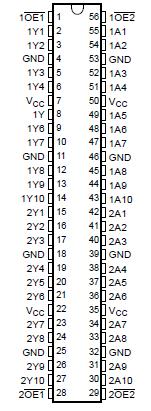
The SN74ALVCH162827 is composed of two 10-bit sections with separate output-enable signals. For either 10-bit buffer section, the two output-enable (1OE1 and 1OE2 or 2OE1 and 2OE2) inputs must both be low for the corresponding Y outputs to be active. If either output-enable input is high, the outputs of that 10-bit buffer section are in the high-impedance state.
The outputs, which are designed to sink up to 12 mA, include equivalent 26- resistors to reduce overshoot and undershoot. To ensure the high-impedance state of SN74ALVCH162827 during power up or power down, OE should be tied to VCC through a pullup resistor; the minimum value of the resistor is determined by the current-sinking capability of the driver.
SN74ALVCH162827 Active bus-hold circuitry holds unused or undriven inputs at a valid logic state. Use of pullup or pulldown resistors with the bus-hold circuitry is not recommended.