Features: Member of the Texas Instruments WidebusTM FamilyEPICTM(Enhanced-Performance Implanted CMOS) Submicron ProcessChecks Parity Able to Cascade With a Secon SN74ALVCH16903 ESD Protection Exceeds 2000 V Per MIL-STD-883, Method 3015; Exceeds 200 V Using Machine Model (C = 200 pF, R = 0) Latch-...
SN74ALVCH16903: Features: Member of the Texas Instruments WidebusTM FamilyEPICTM(Enhanced-Performance Implanted CMOS) Submicron ProcessChecks Parity Able to Cascade With a Secon SN74ALVCH16903 ESD Protection Excee...
SeekIC Buyer Protection PLUS - newly updated for 2013!
268 Transactions
All payment methods are secure and covered by SeekIC Buyer Protection PLUS.

This SN74ALVCH16903 12-bit universal bus driver is designed for 2.3-V to 3.6-V VCC operation.
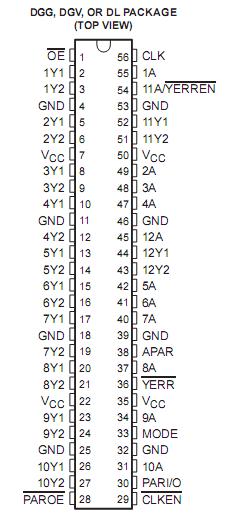
The SN74ALVCH16903 has dual outputs and can operate as a buffer or an edge-triggered register. In both modes, parity is checked on APAR, which arrives one cycle after the data to which it applies. The YERR output, which is produced one cycle after APAR, is open drain.
MODE selects one of the two data paths. When MODE is low, the SN74ALVCH16903 device operates as an edge-triggered register. On the positive transition of the clock (CLK) input and when the clock enable (CLKEN ) input is low, data set up at the A inputs is stored in the internal registers. On the positive transition of CLK and whenCLKEN is high, only data set up at the 9A12A inputs is stored in their internal registers. When MODE is high, the device operates as a buffer and data at the A inputs passes directly to the outputs. 11A/YERREN serves a dual purpose; it acts
as a normal data bit and also enables YERR data to be clocked into the YERR output register.
When used as a single device, parity output enable (PAROE ) must be tied high; when parity input/output (PARI/O) is low, even parity is selected and when PARI/O is high, odd parity is selected. When used in pairs and PAROE is low, the parity sum is output on PARI/O for cascading to the second SN74ALVCH16903. When used in pairs and PAROE is high, PARI/O accepts a partial parity sum from the first SN74ALVCH16903.A buffered output-enable (OE ) input can be used to place the 24 outputs and YERR in either a normal logic state (high or low logic levels) or a high-impedance state. In the high-impedance state, the outputs neither load nor drive the bus lines significantly. The high-impedance state and increased drive provide the capability to drive bus lines without need for interface or pullup components.