Features: UBT TM (Universal Bus Transceiver) Combines D-Type Latches and D-Type Flip-Flops for Operation in Transparent, Latched, or Clocked Mode
State-of-the-Art Advanced BiCMOS Technology (ABT) WidebusTM Design for 2.5-V and 3.3-V Operation and Low Static-Power Dissipation
Support Mixed-Mode Signal Operation (5-V Input and Output Voltages With 2.3-V to 3.6-V VCC)
Typical VOLP (Output Ground Bounce) <0.8 V at VCC = 3.3 V, TA = 25°C
High Drive (24/24 mA at 2.5-V and 32/64 mA at 3.3-V VCC)
Ioff and Power-Up 3-State Support Hot Insertion
Use Bus Hold on Data Inputs in Place of External Pullup/Pulldown Resistors to Prevent the Bus From Floating
Auto3-State Eliminates Bus Current Loading When Output Exceeds VCC + 0.5 V
Flow-Through Architecture Facilitates Printed Circuit Board Layout
Distributed VCC and GND Pins Minimize High-Speed Switching Noise
Packaged in Plastic Fine-Pitch Ball Grid Array Package
Pinout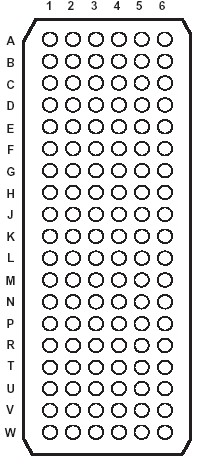 SpecificationsSupply voltage range, VCC . . . . . . . . . . . . . . . . . . . . . . . . . . . . . . . . . . . . . . . .. .0.5 V to 4.6 V
Input voltage range, VI (see Note 1). . . . . . . . . . . . . . . . . . . . . . . . . . . . . . . . . . . . 0.5 V to 7 V
Voltage range applied to any output in the high-impedance
or power-off state, VO (see Note 1) . . . . . . . . . . . . . . . . . . . . . . . . . . . . . .. . . . . . .0.5 V to 7 V
Voltage range applied to any output in the high state, VO (see Note 1) . . . . . . . . .0.5 V to 7 V
Output current in the low state, IO: SN54ALVTH32501 . . . . . . . . . . . . . . . . . . . . . . . . . . .96 mA
SN74ALVTH32501 . . . . . . . . . . . . . . . . . . . . . . . . . .128 mA
Output current in the high state, IO: SN54ALVTH32501 . . . . . . . . . . . .. . . . . . . . . . . . . . . 48 mA
SN74ALVTH32501 . . . . . . . . . . . . . . . . . . . . . . . . . . .64 mA
Continuous current through VCC or GND . . . . . . . . . . . . . . . . . . . . . .. . . . . . . . . . . . . . . .±100 mA
Input clamp current, IIK (VI < 0) . . . . . . . . . . . . . . . . . . . . . . . . . . . . . . . . . . . . . . . . . . . . .50 mA
Output clamp current, IOK (VO < 0) . . . . . . . . . . . . . . . . . . . . . . . . . . . . . . . . . . . . . . . . . . . 50 mA
Package thermal impedance, JA (see Note 2) . . . . . . . . . . . . . . .. . . . . . . . . . . . . . . . . . . .39°C/W
Storage temperature range, Tstg . . . . . . . . . . . . . . . . . . . .. . . . . . . . . . . . . . . . . . .65°C to 150°CDescriptionThe SN74ALVTH32501 devices are 36-bit universal bus transceivers designed for 2.5-V or 3.3-V VCC operation, but with the capability to provide a TTL interface to a 5-V system environment.
These SN74ALVTH32501 devices combine D-type latches and D-type flip-flops to allow data flow in transparent, latched, and clocked modes.
Data flow in each direction is controlled by output-enable (OEAB and OEBA), latch-enable (LEAB and LEBA), and clock (CLKAB and CLKBA) inputs. For A-to-B data flow, the device operates in the transparent mode when LEAB is high. When LEAB is low, the A data is latched if CLKAB is held at a high or low logic level. If LEAB is low, the A data is stored in the latch/flip-flop on the low-to-high transition of CLKAB. Data flow for B to A is similar to that of A to B, but uses OEBA, LEBA, and CLKBA. Output-enable OEAB is active high. When OEAB is high, the outputs are active. When OEAB is low, the outputs are in the high-impedance state. The output enables are complementary (OEAB is active high, and OEBA is active low). These SN74ALVTH32501 devices are fully specified for hot-insertion applications using Ioff and power-up 3-state. The Ioff circuitry disables the outputs, preventing damaging current backflow through the device when they are powered down. The power-up 3-state circuitry places the outputs in the high-impedance state during power up and power down, which prevents driver conflict.
When VCC is between 0 and 1.2 V, the device is in the high-impedance state during power up or power down. However, to ensure the high-impedance state above 1.2 V, OE should be tied to VCC through a pullup resistor and OE should be tied to GND through a pulldown resistor; the minimum value of the resistor is determined by the current-sinking/current-sourcing capability of the driver.
Active bus-hold circuitry is provided to hold unused or floating data inputs at a valid logic level. The SN54ALVTH32501 is characterized for operation over the full military temperature range of 55°C to 125°C. The SN74ALVTH32501 is characterized for operation from 40°C to 85°C.

 SN74ALVTH32501 Data Sheet