Features: • Independent Synchronous Inputs and Outputs• 16 Words by 4 Bits• Data Rates From 0 to 10 MHz• Fall-Through Time . . . 50 ns Typ• Data Terminals Arranged for Printed-Circuit-Board Layout• Expandable Using External Gating• Packaged in Standard Pla...
SN74LS228: Features: • Independent Synchronous Inputs and Outputs• 16 Words by 4 Bits• Data Rates From 0 to 10 MHz• Fall-Through Time . . . 50 ns Typ• Data Terminals Arranged for ...
SeekIC Buyer Protection PLUS - newly updated for 2013!
268 Transactions
All payment methods are secure and covered by SeekIC Buyer Protection PLUS.

This 64-bit memory is a low-power Schottky memory array organized as 16 words by 4 bits. It can be expanded in multiples of 15m + 1 words or 4n bits, or both (where n is the number of packages in the vertical array and m is the number of packages in the horizontal array), however some external gating is required (see Figure 1). For longer words using the SN74LS228, the IR signals of the first-rank packages and OR signals of the last-rank packages must be ANDed for proper synchronization.
A first-in, first-out (FIFO) memory is a storage device that allows data to be written into and read from its array at independent data rates. These FIFOs are designed to process data at rates from 0 to 10 MHz in a bit-parallel format, word by word.
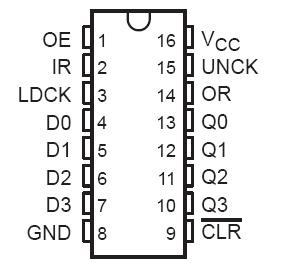
Data is written into memory on a low-to-high transition at the load-clock (LDCK) input and is read out on a low-to-high transition at the unload-clock (UNCK) input. The memory is full when the number of words clocked in exceeds by 16 the number of words clocked out. When the memory is full, LDCK signals have no effect on the data residing in memory. When the memory is empty, UNCK signals have no effect.
Status of the FIFO memory is monitored by the input-ready (IR) and output-ready (OR) flags that indicate not-full and not-empty conditions. IR is high only when the memory is not full and the LDCK is low. OR is high only when the memory is not empty and UNCK is high.
A low level on the clear (CLR) input resets the internal stack-control pointers and also sets IR high and OR low to indicate that old data remaining at the data outputs is invalid. Data outputs are noninverting with respect to the data inputs and are at high impedance when the output-enable (OE) input is low. OE does not affect the IR and OR outputs.
The SN74LS228 is characterized for operation from 0°C to 70°C.