Features: • EPICTM (Enhanced-Performance Implanted CMOS) Submicron Process• Typical VOLP (Output Ground Bounce) < 0.8 V at VCC = 3.3 V, TA = 25°C• Typical VOHV (Output VOH Undershoot) > 2 V at VCC = 3.3 V, TA = 25°C•Latch-Up Performance Exceeds 250 mA Per JEDEC Standa...
SN74LVC652: Features: • EPICTM (Enhanced-Performance Implanted CMOS) Submicron Process• Typical VOLP (Output Ground Bounce) < 0.8 V at VCC = 3.3 V, TA = 25°C• Typical VOHV (Output VOH Under...
SeekIC Buyer Protection PLUS - newly updated for 2013!
268 Transactions
All payment methods are secure and covered by SeekIC Buyer Protection PLUS.

This octal bus transceiver and register SN74LVC652 is designed for 2.7-V to 3.6-V VCC operation.
The SN74LVC652 consists of bus transceiver circuits, D-type flip-flops, and control circuitry arranged for multiplexed transmission of data directly from the data bus or from the internal storage registers.
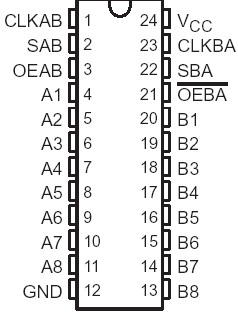
SN74LVC652 Output-enable (OEAB and OEBA) inputs are provided to control the transceiver functions. Select-control (SAB and SBA) inputs are provided to select whether real-time or stored data is transferred. The circuitry used for select control eliminates the typical decoding glitch that occurs in a multiplexer during the transition between stored and real-time data. A low input selects real-time data, and a high input selects stored data. Figure 1 illustrates the four fundamental bus-management functions that can be performed with the SN74LVC652.
Data on the A or B data bus, or both, can be stored in the internal D-type flip-flops by low-to-high transitions at the appropriate clock (CLKAB or CLKBA) inputs regardless of the select- or enable-control pins. When SAB and SBA are in the real-time transfer mode, it is possible to store data without using the internal D-type flip-flops by simultaneously enabling OEAB and OEBA. In this configuration, each output reinforces its input. When all other data sources to the two sets of bus lines are at high impedance, each set of bus lines remains at its last state.
To ensure the high-impedance state during power up or power down, SN74LVC652 OEBA should be tied to VCC through a pullup resistor and OEAB should be tied to GND through a pulldown resistor; the minimum value of the resistor is determined by the current-sinking/current-sourcing capability of the driver.
The SN74LVC652 is characterized for operation from 40°C to 85°C.