Features: Member of the Texas Instruments Widebus™ Family EPIC ™(Enhanced-Performance Implanted CMOS) Submicron Process Typical VOLP (Output Ground Bounce) < 0.8 V at VCC= 3.3 V, TA = 25°C Typical VOHV (Output VOH Undershoot) > 2 V at VCC = 3.3 V, TA = 25°C Supports Mixe...
SN74LVCH16646A: Features: Member of the Texas Instruments Widebus™ Family EPIC ™(Enhanced-Performance Implanted CMOS) Submicron Process Typical VOLP (Output Ground Bounce) < 0.8 V at VCC= 3....
SeekIC Buyer Protection PLUS - newly updated for 2013!
268 Transactions
All payment methods are secure and covered by SeekIC Buyer Protection PLUS.
Member of the Texas Instruments
Widebus™ Family
EPIC ™(Enhanced-Performance Implanted
CMOS) Submicron Process
Typical VOLP (Output Ground Bounce)
< 0.8 V at VCC= 3.3 V, TA = 25°C
Typical VOHV (Output VOH Undershoot)
> 2 V at VCC = 3.3 V, TA = 25°C
Supports Mixed-Mode Signal Operation on
All Ports (5-V Input/Output Voltage With
3.3-V VCC)
Power Off Disables Outputs, Permitting
Live Insertion
ESD Protection Exceeds 2000 V Per
MIL-STD-883, Method 3015; Exceeds 200 V
Using Machine Model (C = 200 pF, R = 0)
Latch-Up Performance Exceeds 250 mA Per
JESD 17
Bus Hold on Data Inputs Eliminates the
Need for External Pullup/Pulldown
Resistors
Package Options Include Plastic 300-mil
Shrink Small-Outline (DL) and Thin Shrink
Small-Outline (DGG) Packages

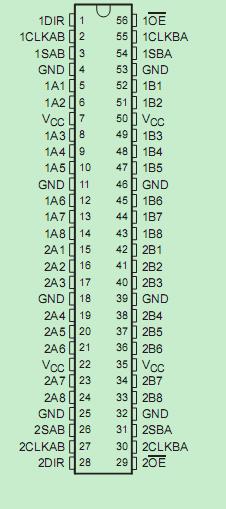
This 16-bit bus transceiver and register is designed for 1.65-V to 3.6-V VCC operation.The SN74LVCH16646A can be used as two 8-bit
transceivers or one 16-bit transceiver. The device consists of bus transceiver circuits, D-type flip-flops, and control circuitry arranged for multiplexed transmission of data directly from the input bus or from the internal registers.
Data on the A or B bus is clocked into the registers on the low-to-high transition of the appropriate clock (CLKAB or CLKBA) input. Figure 1 illustrates the four fundamental bus-management functions that can be performed with the SN74LVCH16646A.
SN74LVCH16646A Output-enable (OE ) and direction-control (DIR) inputs control the transceiver functions. In the transceiver mode, data present at the high-impedance port can be stored in either register or in both. The select-control (SAB and SBA) inputs can multiplex stored and real-time (transparent mode) data. The circuitry used for select control eliminates the typical decoding glitch that occurs in a multiplexer during the transition between stored and real-time data. DIR determines which bus receives data when OE is low. In the isolation mode (OE high), A data can be stored in one register and/or B data can be stored in the other register.