Features: Members of the Texas Instruments WidebusTM FamilyState-of-the-Art Advanced BiCMOS Technology (ABT) Design for 3.3-V Operation and Low Static-Power DissipationSupport Mixed-Mode Signal Operation (5-V Input and Output Voltages With 3.3-V VCC)Support Unregulated Battery Operation Down to 2...
SN74LVT16245B: Features: Members of the Texas Instruments WidebusTM FamilyState-of-the-Art Advanced BiCMOS Technology (ABT) Design for 3.3-V Operation and Low Static-Power DissipationSupport Mixed-Mode Signal Ope...
SeekIC Buyer Protection PLUS - newly updated for 2013!
268 Transactions
All payment methods are secure and covered by SeekIC Buyer Protection PLUS.
Members of the Texas Instruments WidebusTM Family
State-of-the-Art Advanced BiCMOS Technology (ABT) Design for 3.3-V Operation and Low Static-Power Dissipation
Support Mixed-Mode Signal Operation (5-V Input and Output Voltages With 3.3-V VCC)
Support Unregulated Battery Operation Down to 2.7 V
Typical VOLP (Output Ground Bounce) <0.8 V at VCC = 3.3 V, TA = 25°C
Ioff and Power-Up 3-State Support Hot Insertion
Distributed VCC and GND Pins Minimize High-Speed Switching Noise
Flow-Through Architecture Optimizes PCB Layout
Latch-Up Performance Exceeds 100 mA Per JESD 78, Class II
ESD Protection Exceeds JESD 22
2000-V Human-Body Model (A114-A)
200-V Machine Model (A115-A)
1000-V Charged-Device Model (C101)
Package Options Include Plastic Shrink Small-Outline (DL), Thin Shrink Small-Outline (DGG), and Thin Very Small-Outline (DGV) Packages and 380-mil Fine-Pitch Ceramic Flat (WD) Package Using 25-mil Center-to-Center Spacings

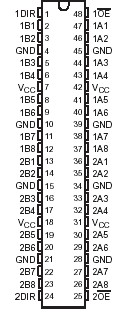
The SN74LVT16245B devices are 16-bit (dual-octal) noninverting 3-state transceivers designed for low-voltage (3.3-V) VCC operation, but with the capability to provide a TTL interface to a 5-V system environment.
These devices SN74LVT16245B can be used as two 8-bit transceivers or one 16-bit transceiver. They allow data transmission from the A bus to the B bus or from the B bus to the A bus, depending on the logic level at the direction-control (DIR) input. The output-enable (OE) input can be used to disable the devices so that the buses are effectively isolated.
When VCC is between 0 and 1.5 V, the devices SN74LVT16245B are in the high-impedance state during power up or power down. However, to ensure the high-impedance state above 1.5 V, OE should be tied to VCC through a pullup resistor; the minimum value of the resistor is determined by the current-sinking capability of the driver.