Features: · Support Mixed-Mode Signal Operation (5-V Input and Output Voltages With 3.3-V VCC)· Support Unregulated Battery Operation Down to 2.7 V· Typical VOLP (Output Ground Bounce) <0.8 V at VCC = 3.3 V, TA = 25°C· Ioff and Power-Up 3-State Support Hot Insertion· Bus Hold on Data Inputs Eli...
SN74LVTH574: Features: · Support Mixed-Mode Signal Operation (5-V Input and Output Voltages With 3.3-V VCC)· Support Unregulated Battery Operation Down to 2.7 V· Typical VOLP (Output Ground Bounce) <0.8 V at ...
SeekIC Buyer Protection PLUS - newly updated for 2013!
268 Transactions
All payment methods are secure and covered by SeekIC Buyer Protection PLUS.

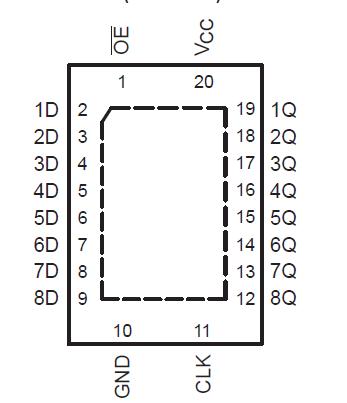
The eight flip-flops of the SN74LVTH574 devices are edge-triggered D-type flip-flops. On the positive transition of the clock (CLK) input, the Q outputs are set to the logic levels set up at the data (D) inputs.
About SN74LVTH574,A buffered output-enable (OE) input can be used to place the eight outputs in either a normal logic state (high or low logic levels) or a high-impedance state. In the high-impedance state, the outputs neither load nor drive the bus lines significantly. The high-impedance state and increased drive provide the capability to drive bus lines without need for interface or pullup components.
OE does not affect the internal operations of the SN74LVTH574 flip-flops. Old data can be retained or new data can be entered while the outputs are in the high-impedance state.
About SN74LVTH574,To ensure the high-impedance state during power up or power down, OE should be tied to VCC through a pullup resistor; the minimum value of the resistor is determined by the current-sinking capability of the driver.
Active bus-hold circuitry is provided by SN74LVTH574 to hold unused or floating data inputs at a valid logic level. Use of pullup or pulldown resistors with the bus-hold circuitry is not recommended.
These devices SN74LVTH574 are fully specified for hot-insertion applications using Ioff and power-up 3-state. The Ioff circuitry disables the outputs, preventing damaging current backflow through the devices when they are powered down.The power-up 3-state circuitry places the outputs in the high-impedance state during power up and power down, which prevents driver conflict.