Features: Provides Differential SCSI from Single-Ended Controller When Used With the SN75LBC971A Data Transceiver
Designed to Operate at Fast-SCSI Speeds of 10 Million Data Transfers per Second
Nine Transceivers Meet or Exceed the Requirements of ANSI Standard EIA-485 and ISO-8482 Standards
Packaged in Shrink Small-Outline Package with 25 mil Terminal Pitch
Low Disabled Supply Current 22 mA Typ
Thermal Shutdown Protection
Positive- and Negative-Current Limiting
Power-Up/-Down Glitch Protection
Pinout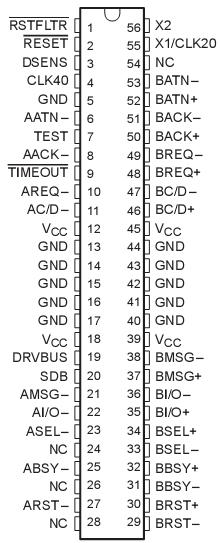 SpecificationsSupply voltage range, VCC (see Note 1) . . . . . . . . . . . . . . . . . . . . . . . . . . . . . . . . . . . . . . . . . . . . . . .0.3 V to 7V
Differential bus voltage range (B side) . . . . . . . . . . . . . . . . . . . . . . . . . . . . . . . . . . . . . . . . . . . . . . 15 V to 15 V
Signal-ended bus voltage range (A side and control) . . . . . . . . . . . . . . . . . . . . . . . . . . . . . . . . . . . 0.3 V to 7 V
Continuous total power dissipation . . . . . . . . . . . . . . . . . . . . . . . . . . . . . . . . . . . . . See Dissipation Rating Table
Electrostatic discharge: B side (see Note 2):Class 2, A: . . . . . . . . . . . . . . . . . . . . . . . . . . . . . . . . . . . . . . . . 2 kV
Class 2, B: . . . . . . . . . . . . . . . . . . . . . . . . . . . . . . . . . . . . . . . . . . . . . . . . . . . . . . . . . . . . . . . . . . . . . . . . . . . 200 V
All terminals: Class 1, A: . . . . . . . . . . . . . . . . . . . . . . . . . . . . . . . . . . . . . . . . . . . . . . . . . . . . . . . . . . . . . . . . 500 V
Class 1, B: . . . . . . . . . . . . . . . . . . . . . . . . . . . . . . . . . . . . . . . . . . . . .. . . . . . . . . . . . . . . . . . . . . . . . . . . . . . 200 V
Operating free-air temperature range, TA . . . . . . . . . . . . . . . . . . . . . . . . . . . . . . . . . . . . . . . . . . . . . . 0 to 70
Storage temperature range, Tstg . . . . . . . . . . . . . . . . . . . . . . . . . . . . . . . . . . . . . . . . . . . . . . . . . . .65to 150
Lead temperature 1,6 mm (1/16 inch) from case for 10 seconds . . . . . . . . . . . . . . . . . . . . . . . . . . . . . . . 260DescriptionThe SN75LBC970A SCSI differential converter-control is an adaptation of the industry's first 9-channel RS-485 transceiver, th SN75LBC976.When used in conjunction with one or more of its companion data transceiver(s), SN75LBC971A,the chip set provides the superior electrical performance of differential SCSI from a single-en-ded SCSI bus controller. A 16-bit, Fast-SCSI bus can be implemented with just three devices (twofor data and one for control) in the space-efficient,56-pin, shrink small-outline package (SSOP) and a few external components.
In SN75LBC970A's typical differential SCSI node, the SCSI controller provides the enables for each external RS-485 transceiver. This could require as many as 27 additional terminals for a 16-bit differential bus controller or relegate a 16-bit single-ended controller to only an 8-bit differential bus. Using the standard nine SCSI control signals, the SN75LBC970A control transceiver decodes the state of the bus and enables the SN75LBC971A data transceiver(s) to transmit the single-ended SCSI input signals differentially to the cable or receive the differential cable signals and drive the single-ended outputs to the controller.
The SN75LBC970A single-ended SCSI bus interface consists of CMOS bidirectional inputs and outputs. The drivers are rated at ±16 mA of output current. The receiver inputs are pulled high with approximately 4 mA to eliminate the need for external pullup resistors for the open-drain outputs of most single-ended SCSI controllers. The single-ended side of the device is not intended to drive the SCSI bus directly.

 SN75LBC970A Data Sheet