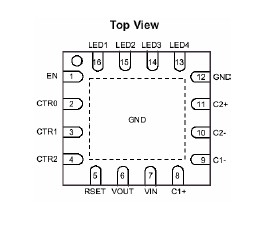
Features: ·Peak Efficiency: 90%·Individual Current Regulation·3-bit Digital Output Control·1x and 1.5x Modes of Operation·Current Matching with a Max Tolerance of 3%·Output Current up to 30mA per LED·Fixed Frequency of 1MHz·Open LED Protection·Pb-Free Thin QFN-16 3mmx3mm PackageApplication·Cellula...
SP6887: Features: ·Peak Efficiency: 90%·Individual Current Regulation·3-bit Digital Output Control·1x and 1.5x Modes of Operation·Current Matching with a Max Tolerance of 3%·Output Current up to 30mA per LE...
SeekIC Buyer Protection PLUS - newly updated for 2013!
268 Transactions
All payment methods are secure and covered by SeekIC Buyer Protection PLUS.

| Specifications | |
| Arch | Charge Pump |
| App | Backlight |
| CH | 4 |
| Vin MIN. (V) | 2.7 |
| Vin MAX. (V) | 5.5 |
| Max Series LEDs | 1 |
| LEDMatching Accuracy (%) (Typ.) | 3 |
| IQ (A) | 600 |
| Efficiency(%) | 90 |
| Specifications | |
| Arch | Charge Pump |
| App | Backlight |
| CH | 4 |
| Vin MIN. (V) | 2.7 |
| Vin MAX. (V) | 5.5 |
| Max Series LEDs | 1 |
| LEDMatching Accuracy (%) (Typ.) | 3 |
| IQ (A) | 600 |
| Efficiency(%) | 90 |
The SP6887 is a 4-channel charge pump white LED driver, capable of driving up to 4 LEDs connected in parallel. The device operates in either 1x mode or 1.5x fractional mode, and it can switch from 1x mode to 1.5x mode automatically when the input voltage decreases. Its internal 4 current sink regulators ensure both LED current matching and brightness uniformity. The LED current can be programmed by an external resistor, RSET, connected between the RSET pin and ground. LED currents of up to 30mA are supported by the input supply voltage over a range of 2.7V to 5.5V, making the device optimized for Li-Ion battery applications. The SP6887 has a fixed switching frequency of 1MHz, allowing the use of very small value ceramic capacitors. The enable input pin allows the device to be placed in shutdown mode while reducing current consumption to less than 1µA. LED dimming can be done by several methods including using a DC voltage to set the RSET pin current, adding a switched resistor in parallel with RSET or applying a PWM signal to CTRx pin or EN pin.