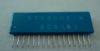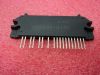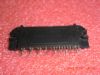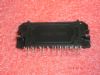
DescriptionThe STK6877 is an H bridge power pack reversible brush-type DC motor driver that uses Sanyo's unique insulated metal substrate technofogy (IMST) substrate.This technology provides superlative thermal dissipation characteristics.By adopting MOSFET devices as its power elements, this hybr...
STK6877: DescriptionThe STK6877 is an H bridge power pack reversible brush-type DC motor driver that uses Sanyo's unique insulated metal substrate technofogy (IMST) substrate.This technology provides superla...
SeekIC Buyer Protection PLUS - newly updated for 2013!
268 Transactions
All payment methods are secure and covered by SeekIC Buyer Protection PLUS.
Specifications Absolute maximum ratingsOutput pin variationLead pinsVCE max [V]600VCC max [V]450...
The STK6877 is an H bridge power pack reversible brush-type DC motor driver that uses Sanyo's unique insulated metal substrate technofogy (IMST) substrate.This technology provides superlative thermal dissipation characteristics.By adopting MOSFET devices as its power elements, this hybrid IC realizes reduced loss and increased current outputs as compared to our earlier STK6860H series.
Features of the STK6877 are:(1)increased margins with respect to rush currents due to the adoption of MOSFET elements; (2)TTL level compatible inputs; (3)support for both two pin control saturation operation and three pin control PWM control; (4)a braking function is provided; (5)wide operating power supply voltage range (Vcc1=12 to 42V); (6)few required external components (operation is possible with only two external bootstrap capacitors).
The absolute maximum ratings of the STK6877 can be summarized as:(1)operating substrate temperature:105;(2)storage temperature range:-40 to 125;(3)maximum supply voltage 1:50V;(4)junction temperature:150;(5)maximum motor rush current:18A;(6)maximum supply voltage 2:7V.When brake method (c} is used, First the PWM input is set to low,and the motor's rotational energy is released to a certain degree.Then full braking is applied by setting both the A and B phase inputs to low.This method allows the flywheel current that flows in the lower MOSPETs to be held to within the maximum rated range by first applying method (b) braking, and then when the motor's rotational energy has been reduced, applying method (a) braking to stop the motor.It is conceivable that both the upper and lower MOSFETs could be in the on state at the same time during braking operations(braking methods (a) and (c)) and release states.Taking this into consideration, the STK6877 provides two dead times (td 1 and td2) of at least 1 s with respect to the input signals in the upper and lower MOSFET drive circuits as shown in the figure below.As a result there is no need for concern about shorting currents in the upper and lower MOSFETs.