Features: ` Quad PECL version of popular ECLinPS E111` Low skew` Guaranteed skew spec` TTL enable input` Selectable TTL or PECL clock input`Single +5V supply` Differential internal design` PECL I/O fully compatible with industry standard` Internal 75k PECL input pull-down resistors` Available in 1...
SY100S815: Features: ` Quad PECL version of popular ECLinPS E111` Low skew` Guaranteed skew spec` TTL enable input` Selectable TTL or PECL clock input`Single +5V supply` Differential internal design` PECL I/O ...
SeekIC Buyer Protection PLUS - newly updated for 2013!
268 Transactions
All payment methods are secure and covered by SeekIC Buyer Protection PLUS.
DescriptionThe SY10/100E111 are low skew 1-to-9 differential drivers designed for clock distributi...

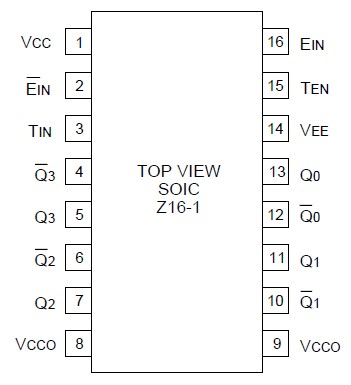
The SY100S815 is a low skew 1-to-4 PECL differential driver designed for clock distribution in new, highperformance PECL systems. SY100S815 accepts either a PECL clock input or a TTL input by using the TTL enable pin TEN. When the TTL enable pin is HIGH, the TTL input is enabled and the PECL input is disabled. When the enable pin is set LOW, the TTL input is disabled and the PECL input is enabled.
The SY100S815 is specifically designed and produced for low skew. The interconnect scheme and metal layout are carefully optimized for minimal gate-to-gate skew within the device. Wafer characterization and process control ensure consistent distribution of propagation delay from lot to lot. Since the SY100S815 shares a common set of "basic" processing with the other members of the ECLinPS family wafer characterization at the point of device personalization allows for tighter control of parameters, including propagation delay.
To ensure that the skew specification is met, SY100S815 is necessary that both sides of the differential output are terminated into 50, even if only one side is being used. In most applications, all nine differential pairs will be used and, therefore, terminated. In the case where fewer than nine pairs are used, SY100S815 is necessary to terminate at least the output pairs on the same package side (i.e. sharing the same VCCO as the pair(s) being used on that side) in order to maintain minimum skew.