Features: · 3.3V and 5V power supply options· 3.0GHz typical toggle frequency· 310ps typical propagation delay· 1.6V (5V) and 1.4V (3.3V) swing· Internal input resistors: pulldown on D, pulldown and pullup on /D· New differential input common mode range· Available in 8-pin MSOP and SOIC packagesPi...
SY10EP89V: Features: · 3.3V and 5V power supply options· 3.0GHz typical toggle frequency· 310ps typical propagation delay· 1.6V (5V) and 1.4V (3.3V) swing· Internal input resistors: pulldown on D, pulldown and...
SeekIC Buyer Protection PLUS - newly updated for 2013!
268 Transactions
All payment methods are secure and covered by SeekIC Buyer Protection PLUS.
DescriptionThe SY10/100E111 are low skew 1-to-9 differential drivers designed for clock distributi...

Symbol |
Rating |
Value |
Unit |
VCC-VEE |
Power Supply Voltage | 6V |
V |
VIN |
Input Voltage (VCC = 0V, VIN not more negative than VEE) Input Voltage (VEE = 0V, VIN not more positive than VCC) |
6.0 to 0 +6.0 to 0 |
V V |
IOUT |
Output Current Continuous 50 mA Surge |
50 100 |
mA |
TA |
Operating Temperature Range | 40 to +85 |
|
Tstore |
Storage Temperature Range | 65 to +150 |
|
JA |
Package Thermal ResistanceStill-Air(SOIC) (Junction-to-Ambient) 500lfpm (SOIC) -Still-Air (MSOP) 500lfpm (MSOP) |
160 109 206 155 |
/W /W |
JC |
Package Thermal Resistance (SOIC) (Junction-to-Case) (MSOP) |
399 399 |
/W |
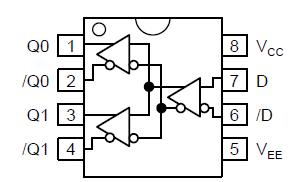
The SY10EP89V is a differential fanout gate specifically designed to drive coaxial cables. The SY10EP89V is especially useful in digitial video broadcasting applications; for this application, since the system is polarity free, each output can be used as an independent driver. The driver of SY10EP89V produces swings 70% larger than a standard ECL output. When driving a coaxial cable, proper termination is required at both ends of the line, while maintaining a 800mV (5V) or 700mV (3.3V) swing at the receiving end of the cable. Because of the larger output swings, the device cannot be terminated into the standard VCC 2.0V. All of the DC parameters are tested with a 50 to VCC 3.0V load. The driver accepts a standard differential ECL input and can run off of the digital video broadcast standard 5.0V supply.