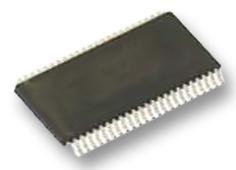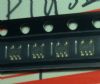
Features: Wide supply voltage range from 0.8 V to 3.6 V High noise immunity Complies with JEDEC standards: JESD8-12 (0.8 V to 1.3 V) JESD8-11 (0.9 V to 1.65 V) JESD8-7 (1.2 V to 1.95 V) JESD8-5 (1.8 V to 2.7 V) JESD8-B (2.7 V to 3.6 V)ESD protection: HBM JESD22-A114-D Class 3A exceeds 5000 V ...
74AUP1G74: Features: Wide supply voltage range from 0.8 V to 3.6 V High noise immunity Complies with JEDEC standards: JESD8-12 (0.8 V to 1.3 V) JESD8-11 (0.9 V to 1.65 V) JESD8-7 (1.2 V to 1.95 V) JESD8-5 (...
SeekIC Buyer Protection PLUS - newly updated for 2013!
268 Transactions
All payment methods are secure and covered by SeekIC Buyer Protection PLUS.

| Symbol | Parameter | Conditions |
Min |
Max |
Unit |
| VCC | supply voltage |
-0.5 |
+4.6 |
V | |
| IIK | input clamping current | VI < 0 V |
- |
-50 |
mA |
| VI | input voltage |
-0.5 |
+4.6 |
V | |
| IOK | output clamping current | VO < 0 V |
- |
-50 |
mA |
| VO | output voltage | Active mode and Power-down mode |
-0.5 |
+4.6 |
V |
| IO | output current | VO = 0 V to VCC |
- |
±20 |
mA |
| ICC | supply current |
- |
+50 |
mA | |
| 74AUP1G74_1 |
© Koninklijke Philips Electronics N.V. 2006. All rights reserved. | ||||
The 74AUP1G74 is a high-performance, low-power, low-voltage, Si-gate CMOS device,
superior to most advanced CMOS compatible TTL families.
Schmitt-trigger action of the 74AUP1G74 at all inputs makes the circuit tolerant to slower input rise and fall times across the entire VCC range from 0.8 V to 3.6 V. This device ensures a very low static and dynamic power consumption across the ntire VCC range from 0.8 V to 3.6 V.
The 74AUP1G74 is fully specified for partial Power-down applications using IOFF. The IOFF circuitry disables the output, preventing the damaging backflow current hrough the device when it is powered down.
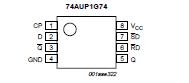
The 74AUP1G74 provides the single positive-edge triggered D-type flip-flop with ndividual data (D) input, clock (CP) input, set (SD) and reset (RD) inputs and omplementary Q and Q outputs. The set and reset are asynchronous active LOW inputs and operate independently of the clock input. Information on the data input is transferred to the Q output on the LOW-to-HIGH transition of the clock pulse. The D input must be stable one set-up time prior to the LOW-to-HIGH clock transition for predictable operation.