Features: `Quad Integrated I/Q Demodulator
`16 Phase Select on each Output (22.5° per step)
`Quadrature Demodulation Accuracy
Phase Accuracy ±1°
Amplitude Balance ±0.25 dB
`Bandwidth
4LO: LF 100 MHz; RF: LF - 25 MHz
Baseband: determined by external filtering
`Output Dynamic Range 158 dB (1 Hz Bandwidth)
`LO Drive > 10 dBm (50 ); 200 mVpp
`Supply: ±5 V
`Power Consumption 73 mW/channel (290 mW total)
`Power Down via SPI (Each Channel and Complete Chip)Application·Medical Imaging (CW Ultrasound Beamforming)
·Phased Array Systems
Radar
Adaptive Antennas
·Communication ReceiversPinout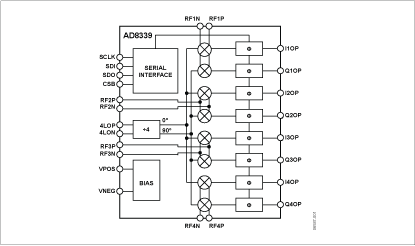
 Specifications
| Function |
Demod |
| RF Freq (MHz) |
dc to 50 |
| IQ Freq (MHz) |
50MHz |
| Phase Error (deg) |
1Deg |
| Amplitude Error (dB) |
0.25dB |
| NF |
8dB |
| Voltage Supply (V) |
4.5 to 5.5 |
| Supply Current |
35mA |
| Package |
40-Lead LFCSP |
DescriptionThe AD8339 is a Quad I/Q demodulator intended to be driven by a low noise preamplifier with differential outputs; it is optimized for the LNA in the AD8332/4/5 family of VGAs. The part consists of four identical I/Q demodulators with a 4x local oscillator (LO) input that divides this signal and generates the necessary 0° and 90° phases of the internal LO that drive the mixers. The four I/Q demodulators can be used independently of each other (assuming that a common LO is acceptable) since each has a separate RF input.
The major application of AD8339 is continuous wave (CW) analog beamforming in ultrasound. Since in a beamforming application the outputs of many channels are summed coherently, the signals need to be phase aligned. A reset pin for the LO divider that synchronizes multiple ICs to start in the same quadrant is provided. Sixteen discrete phase rotations in 22.5° increments can be selected independently for each channel. For example, if CH1 is used as a reference and CH2 has an I/Q phase lead of 45°, then by choosing the correct code one can phase align CH2 with CH1.
The mixer outputs of AD8339 are provided in current form so that they can be easily summed. The summed current outputs, one each for the I and Q signals, will need to be converted to a voltage by a high dynamic range current-to-voltage (I-V) converter. A good choice for this transimpedance amplifier is the AD8021 because of its low noise. Following the current summation the combined signal is presented to a high resolution AD converter (ADC) like the AD7665 (16b/570 ksps).
An SPI compatible serial interface is provided for ease of programming the phase of each channel; the interface allows daisychaining by shifting the data through each chip from SDI to SDO. The SPI also allows for power down of each ndividual channel and the complete chip. During power down the serial interface remains active so that the device can be programmed again.
The dynamic range is >158 dB (1 Hz BW) at the I and Q outputs. Note that the following transimpedance amplifier is an important element in maintaining this dynamic range and attention needs to be paid to component selection. TheD8339 will be available in a 6x6 mm 40 pin LFCSP for the industrial temperature range of -40 to +85.

 AD8339 Data Sheet