Features: • Typical tSK(o) (Output Skew) < 250ps• ESD > 2000V per MIL-STD-883, Method 3015; > 200V using machine model (C = 200pF, R = 0)• VCC = 3.3V ± 0.3V, Normal Range• VCC = 2.7V to 3.6V, Extended Range• CMOS power levels (0.4 W typ. static)• All in...
IDT74LVC16543A: Features: • Typical tSK(o) (Output Skew) < 250ps• ESD > 2000V per MIL-STD-883, Method 3015; > 200V using machine model (C = 200pF, R = 0)• VCC = 3.3V ± 0.3V, Normal Range&...
SeekIC Buyer Protection PLUS - newly updated for 2013!
268 Transactions
All payment methods are secure and covered by SeekIC Buyer Protection PLUS.

|
Symbol |
Description |
Max |
Unit |
|
VTERM |
Terminal Voltage with Respect to GND |
0.5 to +6.5 |
V |
|
TSTG |
Storage Temperature |
65 to +150 |
°C |
|
IOUT |
DC Output Current |
50 to +50 |
mA |
|
IIK IOK |
Continuous Clamp Current, VI < 0 or VO < 0 |
50 |
mA |
|
ICC ISS |
Continuous Current through each VCC or GND |
±100 |
mA |
NOTE:
1. Stresses greater than those listed under ABSOLUTE MAXIMUM RATINGS may cause permanent damage to the device. This is a stress rating only and functional operation of the device at these or any other conditions above those indicated in the operational sections of this specification is not implied. Exposure to absolute maximum rating conditions for extended periods may affect reliability.
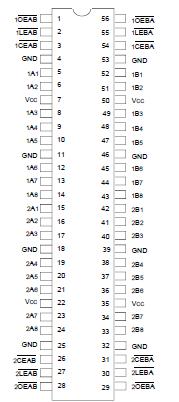
The IDT74LVC16543A 16-bit registered transceiver is built using advanced dual metal CMOS technology. This high-speed, low-power device can be used as two 8-bit transceivers or one 16-bit transceiver. Separate latchenable (LEAB orLEBA) and output-enable (OEAB orOEBA) inputs are provided for each register to permit independent control in either direction of data flow. For example, the A-to-B enable (CEAB) must be low to enter data from the A port or to output data from the B port. LEAB controls the latch function. When LEAB is low, the latches of the IDT74LVC16543A are transparent. A subsequent low-to-high transition of LEAB signal puts the A latches in the storage mode. OEAB performs the output enable function on the B port. Data flow from the B port to the A port is similar but requires using CEBA, LEBA, and OEBA inputs. Flow-through organization of signal pins simplifies layout. All inputs are designed with hysteresis for improved noise margin.
All pins of this 16-bit latched transceiver can be driven from either 3.3V or 5V devices. This feature allows the use of this device as a translator in a mixed 3.3V/5V supply system.
The IDT74LVC16543A has been designed with a ±24mA output driver. This driver is capable of driving a moderate to heavy load while maintaining speed performance.