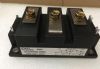
DescriptionThe RC7310 is a low cost High Speed Driver capable of over 250 MHz operation at ECL levels and greater than 1.2 V/ns slew rate for 5 Vp-p output. The driver offers programmable output levels between -3.0V and +8V and an output amplitude up to 10 Vp-p. It is therefore capable of driving any logic family such as ECL, TTL and CMOS. The high and low limits of the output swing are set through the program pins VH and VL, respectively. The transfer characteristic from the program pins to the output pin is unity gain with low offset (30 mV typical) and offset drift (0.1 mV/°C typical). The VH and VL inputs have been buffered to operate with low bias currents (1.0 A typical) allowing direct coupling to the output of a DAC. The RC7310 is normally driven by ECL levels. However, the input common mode range, -2V to +6V, is wide enough to accommodate TTL or CMOS input signals. When driven with a single ended signal the other input of the RC73 10 must be tied to the appropriate threshold voltage. The RC7310 is specified at nominal power supply values of 10V and and commensurate output voltage swing limits of -3.0V and +8V.
The features of RC7310 can be summarized as (1)high output slew rate (1.2 V/ns minimum); (2)wide output voltage range to and up to 10 Vp-p swings; (3)250 MHz minimum operation for ECL swings; (4)wide input common mode range for ease of interface to ECL as well as TTL and CMOS; (5)output short-circuit protection with current limiter and thermal shutdown; (6)100 mA dynamic switching current drive; (7)absolute slew rate control; (8)low output voltage offset (30 mV typ.) and output offset drift (0.1 mV/°C typ.); (9)low input bias current (1 A typ.) and current drift (40 nA/°C typ.) for output level program voltage allows direct coupling to a DAC output; (10)available in 28-pin PLCC.
The absolute maximum ratings of RC7310 are (1)positive power supply, VCC:13V; (2)negative power supply, VEE:-8.2V; (3)difference between VCC and VEE: 16V; (4)input voltage at VlN+VlN-, lNH+, INH-: VCC-12 to VEE+12 V; (5)input voltage at VH, VL: VCC-13 to VEE+13V; (6)difference between VH & VL:13V; (7)lead temperature range (soldering 10 seconds):300°C; (8)storage temperature range: -65°C to +125°C; (9)driver output voltage: VCC-13V to VEE+13V; (10)output voltage at TS: 7V; (11)duration of short-circuit to ground: indefinite; (12)operating temperature range: 70°C. ("Absolute maximum ratings" are those beyond which the safety of the device cannot be guaranteed. They are not meant to imply that the device should be operated at these limits. If the device is subjected to the limits in the absolute maximum ratings for extended periods, RC7310's reliability may be impaired. The tables of electrical characteristics provide conditions for actual device operation. )

 RC7310 Data Sheet