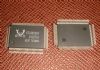
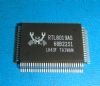
Features: `208 pin QFP
`Supports descriptor-based buffer management
`Supports Microsoft* NDIS5 Checksum Offloads (IP,
TCP, UDP), and Largesend Offload
`Supports IEEE 802.1Q VLAN tagging
`Supports Transmit (Tx) Priority Queue for QoS, CoS applications
`Supports major Tally Counters
`10Mbps, 100Mbps, and 1000Mbps operation at
MII/GMII, and 1000Mbps at TBI interfaces
`Supports 10Mbps, 100Mbps, and 1000Mbps N-way Auto-negotiation operation
`PCI local bus single-chip Fast Ethernet controller
-Supports both Little-Endian and Big-Endian
-Supports 16.75MHz-66MHz PCI clock
-Supports both 32-bit and 64-bit PCI bus
-Supports PCI target fast back-to-back transaction
-Supports Memory Read Line, Memory Read
Multiple, Memory Write and Invalidate, and Dual Address Cycle
`Provides PCI bus master data transfers and PCI
memory space or I/O space mapped data
transfers of the RTL8169 operational registers
-Supports PCI VPD (Vital Product Data)
-Supports ACPI, PCI power management
-Supports optional PCI multi-function with
additional slave mode only functions
`Supports CardBus. The CIS can be stored in 93C56 or expansion ROM
`Supports Boot ROM interface. Up to 128K bytes Boot
ROM interface for both EPROM and Flash memory
can be supported
`Supports 125MHz OSC as the internal clock source or
125MHz clock provided from external PHYceiver
`Compliant to PC97, PC98, PC99 and PC2001 standards
`Supports Wake-On-LAN function and remote wake-up
(Magic Packet*, LinkChg and Microsoft® wake-up frame)
`Supports 4 Wake-On-LAN (WOL) signals (active high,
active low, positive pulse, and negative pulse)
`Supports auxiliary power-on internal reset, to be ready
for remote wake-up when main power still remains off
`Supports auxiliary power auto-detect, and sets the
related capability of power management registers in PCI
configuration space
`Advanced power saving mode when LAN function or
wakeup function is not used
`3.3V and 1.8V power supplies needed
`5V tolerant I/Os
`Includes a programmable, PCI burst size and early Tx/Rx threshold
`Supports a 32-bit general-purpose timer with the
external PCI clock as clock source, to generate timer-interrupt
`Contains two large independent transmit (8KB) and receive (48KB) FIFO devices
`Uses 93C46 (64*16-bit EEPROM) or 93C56
(128*16-bit EEPROM) to store resource configuration,
ID parameter, and VPD data. The 93C56 can also be
used to store the CIS data structure for CardBus applications
`Supports LED pins for various network activity indications
`Supports both digital and external analog loopback
`Half/Full duplex capability (only Full duplex operation at 1000Mbps)
`Supports Full Duplex Flow Control (IEEE 802.3x)
* Third-party brands and names are the property of their respective owners.
These specifications are subject to change without notice.Pinout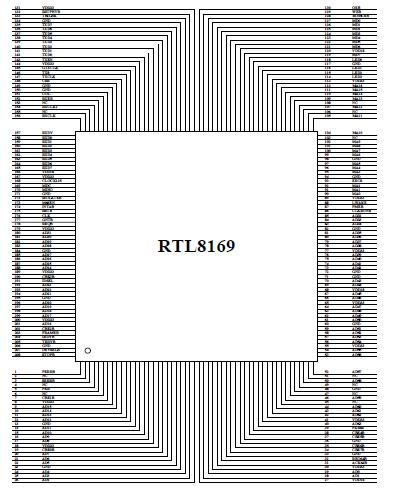 Description
The Realtek RTL8169 is a highly integrated, high performance PCI Gigabit Ethernet Media Access Controller for use in network adapters for servers and personal computers. The RTL8169 fully implements the 33/66MHz, 32/64-bit PCI v2.2 bus interface for host communications with power management and is compliant with the IEEE 802.3 specification for 10/100Mbps Ethernet and the IEEE 802.3z specification for 1000Mbps Ethernet. The RTL8169 supports the auxiliary power auto-detect function, and will auto-configure related bits of the PCI power management registers in PCI configuration space.
It also supports the Advanced Configuration Power management Interface (ACPI), PCI power management for modern operating systems that are capable of Operating System directed Power Management (OSPM) to achieve the most efficient power management system possible.
In addition to the ACPI feature, the RTL8169 also supports remote wake-up (including AMD Magic Packet, LinkChg, and Microsoft® wake-up frame) in both ACPI and APM environments. The RTL8169 is capable of performing an internal reset through the application of auxiliary power. When the auxiliary power is applied and the main power remains off, the RTL8169 is ready and waiting for the Magic Packet or Link Change to wake the system up. Also, the LWAKE pin provides four different output signals including active high, active low, positive pulse, and negative pulse. The versatility of the RTL8169 LWAKE pin provides motherboards with Wake-On-LAN (WOL) functionality.
The PCI specification is inherently little-endian. The RTL8169 contains the ability to do little-endian to big-endian swaps. It is also possible that the RTL8169 can be used as a basis for a RISC CPU platform which expect the data to be in a big-endian format. This feature allows for maximum flexibility.
PCI Vital Product Data (VPD) is also supported to provide the information that uniquely identifies hardware (i.e., the RTL8169 LAN card). The information may consist of part number, serial number, and other detailed information.
The RTL8169 is fully compliant to Microsoft® NDIS5 (IP, TCP, UDP) Checksum and Segmentation Task-offload features, and supports IEEE802.1Q Virtual bridged Local Area Network (VLAN). All the above RTL8169 features contribute to lowering CPU utilization, which is a benefit in operation as a server network card. Also, the RTL8169 boosts its PCI performance by supporting PCI Memory Read Line & Memory Read Multiple when transmitting, and Memory Write and Invalidate when
receiving. To be better qualified as a server card, the RTL8169 also supports the PCI Dual Address Cycle (DAC) command, when the assigned buffers reside at a physical memory addresses higher than 4 Gigabytes. For QoS, CoS requirements, the RTL8169 supports hardware high priority queues to reduce software implementation effort and significantly improve
performance.
The RTL8169 keeps network maintenance costs low and eliminates usage barriers. It is the easiest way to upgrade a network from 10/100Mbps to 1000Mbps. It also supports full-duplex operation, making possible 2000Mbps of bandwidth at no additional cost. For special applications, the RTL8169 also supports a TBI interface, which can be used to provide a connection to a Fiber channel, using a Fiber transceiver.

 RTL8169 Data Sheet