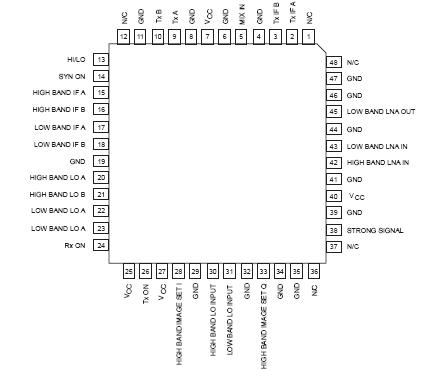
Features: • Low current consumption• Outstanding low- and high-band noise figure• Excellent gain stability versus temperature and supply• Image reject high-band mixer with over 30 dB of rejection• Increased low-band LNA gain compression during analog transmission̶...
SA1921: Features: • Low current consumption• Outstanding low- and high-band noise figure• Excellent gain stability versus temperature and supply• Image reject high-band mixer with ov...
SeekIC Buyer Protection PLUS - newly updated for 2013!
268 Transactions
All payment methods are secure and covered by SeekIC Buyer Protection PLUS.
• 800 to 1000 MHz analog and digital receivers
• 1515 to 1600 MHz digital receivers
• Portable radios
• Digital mobile communications equipment

| SYMBOL | PARAMETERS | VALUE | UNIT |
| VCC | Input supply voltage at pins: 7, 25, 27, 40 | 4.75 | V |
| PD | Power dissipation | 150 | mW |
| PIN | Input power at all ports | +20 | dBm |
| Tsrg | Storage temperature range | 65 to +125 |
The SA1921 is an integrated dual-band RF front-end that operates at both cellular (AMPS, DAMPS, and GSM) and satellite (15151600 MHz) frequencies, and is designed in a 13 GHz fT BiCMOS process-QUBiC1. The low-band is a combined low-noise amplifier (LNA) and mixer. The LNA SA1921 has a 1.7 dB noise figure at 943 MHz with 18.3 dB of gain and an IIP3 of 5 dBm. The wide-dynamic range mixer has a 11 dB noise figure at 943 MHz with 7.2 dB of gain and an IIP3 of +5 dBm.
The high-band SA1921 contains a receiver front-end, and a high frequency transmit mixer intended for closed loop transmitters. One advantage of the high-band architecture is an image-rejection mixer with over 30 dB of image rejection; thus, eliminating external filter cost while saving board space. The system noise figure is 3.9 dB at 1550 MHz with a power gain of 22.2 dB and an IIP3 of 11.5 dB.