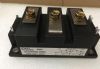
Features: • Enhanced low power 8051 CPU with extended addressing modes for contact and contactless smart card applications
• Instruction set opcode compatible with standard 8051 processor with additional powerful instructions optimized for smart card application
• Dedicated, non-standard architecture with execution time 6 times faster (18 times using PLLmax) than standard 8051 processor at same external clock
• 70 Kbytes User ROM for operating system and application (programs & data)
• 2 Kbytes reserved ROM for Resource Management System (RMS_E) with Contactless Optimized EEPROM write/erase routines
• 8 Kbytes Secure EEPROM in SuperSlim technology for application program and data
• 2048 bytes XRAM and 256 bytes internal RAM for fast data processing
• Memory Management Unit
• Certified True Random Number
Generator
• Dual Key Triple DES (DDES) & GF (2n) Elliptic Curve (EC2) Accelerator
• CRC Module according to ISO/IEC 3309 supporting CCIT v.41 & HDLC X25
• 8 Interrupt Vectors Module with 3 priority levels to ensure real time operation
• PLL: to speed up the internal CPU clock frequency up to 15MHz (optional use)
• Two 16-bit Timer with interrupt capability for protocols, security checks & watch dog implementations
• Power saving sleep and clock stop modes
• Temperature range:
contact-based: -25 to +85
contact-less: -25 to +70Pinout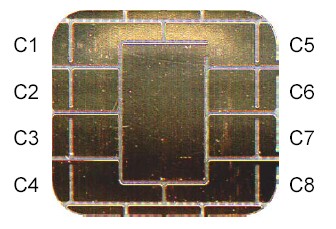 Description
The dual interface security controller SLE 66CL80P is a member of the Infineon Technologies SLE 66CxxxP high-end security controller family in 0.22 µm CMOS technology which is designed for security systems that requires continuous ongoing improvements with the highest degree of protection against fraudulent attacks.
SLE 66CL80P is targeting both contact-based and contactless smart card applications such like Banking, Pay TV, security access, digital signature and transport.
SLE 66CL80P offers 70 Kbytes of User-ROM, 256 bytes internal RAM, 2048 bytes XRAM and 8 Kbytes EEPROM, which can be used as data and as program memory. The non-volatile memory consists of high reliability cells to guarantee data integrity. This is especially important when the EEPROM is used as program memory.
It features ISO/IEC 14443 Type A and B contactless interfaces as well as an ISO/IEC 7816 contact-based interface on a single chip that can be operated in parallel. It also supports symmetric and asymmetric public-key algorithm such like DES and Elliptic Curve independently of the operation and communication mode.

 SLE66CL80P Data Sheet