Features: *Members of the Texas Instruments Widebus Family* A-Port Outputs Have Equivalent 22-Ω Series Resistors, So No External Resistors Are Required* Support Mixed-Mode Signal Operation (5-V Input and Output Voltages With 3.3-V VCC)* Support Unregulated Battery Operation Down to 2...
SN54LVT162245A: Features: *Members of the Texas Instruments Widebus Family* A-Port Outputs Have Equivalent 22-Ω Series Resistors, So No External Resistors Are Required* Support Mixed-Mode Signal Opera...
SeekIC Buyer Protection PLUS - newly updated for 2013!
268 Transactions
All payment methods are secure and covered by SeekIC Buyer Protection PLUS.
Features: PinoutSpecificationsDescriptionThe SN54/74LS147 and SN54/74LS148 are Priority Encoders. ...
PinoutDescriptionThe LS155 and LS156 are Dual 1-of-4 Decoder/Demultiplexers with common Address in...

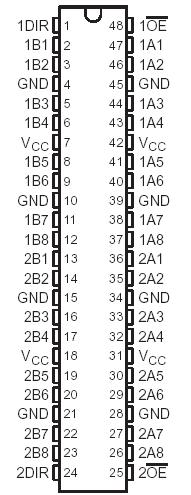
The 'LVT162245A devices are 16-bit (dual-octal) noninverting 3-state transceivers designed for low-voltage (3.3-V) VCC operation, but with the capability to provide a TTL interface to a 5-V system environment.
LVT162245A can be used as two 8-bit transceivers or one 16-bit transceiver. The devices allow data transmission from the A bus to the B bus or from the B bus to the A bus, depending on the logic level at the direction-control (DIR) input. The output-enable (OE) input of LVT162245A can be used to disable the device so that the buses are effectively isolated.
The A-port outputs, LVT162245A is designed to source or sink up to 12 mA, include equivalent 22-Ω series resistors to reduce overshoot and undershoot.
When VCC is between 0 and 1.5 V, the LVT162245A is in the high-impedance state during power up or power down. However, to ensure the high-impedance state above 1.5 V, OE should be tied to VCC through a pullup resistor; the minimum value of the resistor is determined by the current-sinking capability of the driver.
LVT162245A is fully specified for hot-insertion applications using Ioff and power-up 3-state. The Ioff circuitry disables the outputs, preventing damaging current backflow through the devices when they are powered down. The power-up 3-state circuitry places the outputs in the high-impedance state during power up and power down, which prevents driver conflict.