Features: EPICTM (Enhanced-Performance Implanted CMOS) Submicron ProcessTypical VOLP (Output Ground Bounce) < 0.8 V at VCC = 3.3 V, TA = 25°CTypical VOHV (Output VOH Undershoot) > 2 V at VCC = 3.3 V, TA = 25°CLatch-Up Performance Exceeds 250 mA Per JEDEC Standard JESD-17Package Options Inclu...
SN74LVC821: Features: EPICTM (Enhanced-Performance Implanted CMOS) Submicron ProcessTypical VOLP (Output Ground Bounce) < 0.8 V at VCC = 3.3 V, TA = 25°CTypical VOHV (Output VOH Undershoot) > 2 V at VCC =...
SeekIC Buyer Protection PLUS - newly updated for 2013!
268 Transactions
All payment methods are secure and covered by SeekIC Buyer Protection PLUS.

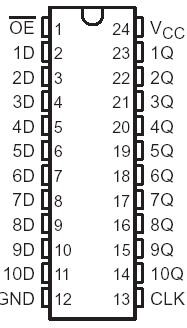
This 10-bit bus-interface flip-flop SN74LVC821 is designed for 2.7-V to 3.6-V VCC operation.
The SN74LVC821 features 3-state outputs designed specifically for driving highly capacitive or relatively low-impedance loads. They are particularly suitable for implementing wider buffer registers, I/O ports, bidirectional bus drivers with parity, and working registers.
The SN74LVC821 ten flip-flops are edge-triggered D-type flip-flops. On the positive transition of the clock (CLK) input, the device provides true data at the Q outputs.
SN74LVC821 A buffered output-enable (OE) input can be used to place the ten outputs in either a normal logic state (high or low level) or a high-impedance state. In the high-impedance state, the outputs neither load nor drive the bus lines significantly. The high-impedance state and increased drive provide the capability to drive bus lines without need for interface or pullup components.
The SN74LVC821 output-enable (OE) input does not affect the internal operations of the latch. Previously stored data can be retained or new data can be entered while the outputs are in the high-impedance state.
SN74LVC821 Inputs can be driven from either 3.3-V or 5-V devices. This feature allows the use of these devices as translators in a mixed 3.3-V/5-V system environment.
To ensure the high-impedance state during power up or power down, SN74LVC821 OE should be tied to VCC through a pullup resistor; the minimum value of the resistor is determined by the current-sinking capability of the driver.
The SN74LVC821 is characterized for operation from 40°C to 85°C.