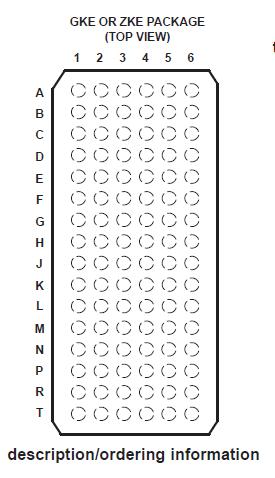
Features: ` Member of the Texas Instruments Widebus+™Family` Output Ports Have Equivalent 22- Series Resistors, So No External Resistors Are Required` Supports Mixed-Mode Signal Operation (5-V Input and Output Voltages With 3.3-V VCC)` Supports Unregulated Battery Operation Down to 2.7 V` Ty...
SN74LVTH32237: Features: ` Member of the Texas Instruments Widebus+™Family` Output Ports Have Equivalent 22- Series Resistors, So No External Resistors Are Required` Supports Mixed-Mode Signal Operation (5-V...
SeekIC Buyer Protection PLUS - newly updated for 2013!
268 Transactions
All payment methods are secure and covered by SeekIC Buyer Protection PLUS.

The SN74LVTH322374 is a 32-bit edge-triggered D-type flip-flop with 3-state outputs designed for low voltage (3.3-V) VCC operation, but with the capability to provide a TTL interface to a 5-V system environment. It is particularly suitable for implementing buffer registers, I/O ports, bidirectional bus drivers, and working registers.
This device SN74LVTH32237 can be used as four 8-bit flip-flops, two 16-bit flip-flops, or one 32-bit flip-flop. On the positive
transition of the clock (CLK), the Q outputs of the flip-flop take on the logic levels set up at the D inputs. A buffered output-enable (OE) input can be used to place the eight outputs in either a normal logic state (high or low logic levels) or the high-impedance state. In the high-impedance state, the outputs neither load nor drive the bus lines significantly. The high-impedance state and the increased drive provide the capability to drive bus lines without need for interface or pullup components.
OE does not affect internal operations of the flip-flop. Old data can be retained or new data can be entered while the outputs are in the high-impedance state.
The SN74LVTH32237 outputs, which are designed to source or sink up to 12 mA, include equivalent 22- series resistors to reduce overshoot and undershoot.
About SN74LVTH32237,Active bus-hold circuitry holds unused or undriven inputs at a valid logic state. Use of pullup or pulldown resistors with the bus-hold circuitry is not recommended.
When VCC is between 0 and 1.5 V, the devices SN74LVTH32237 are in the high-impedance state during power up or power down. However, to ensure the high-impedance state above 1.5 V, OE should be tied to VCC through a pullup resistor; the minimum value of the resistor is determined by the current-sinking capability of the driver.
This device SN74LVTH32237 is fully specified for hot-insertion applications using Ioff and power-up 3-state. The Ioff circuitry
disables the outputs, preventing damaging current backflow through the device when it is powered down. The power-up 3-state circuitry places the outputs in the high-impedance state during power up and power down, which prevents driver conflict.