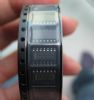
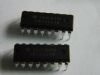
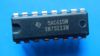
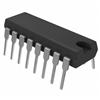
Features: Provides High-Voltage Differential SCSI
From Single-Ended Controller When Used
With the SN75970B Control Transceiver
Meets or Exceeds the Requirements of EIA
Standard RS-485 and ISO-8482 Standards
ESD Protection on Bus Pins to 12 kV
Packaged in Shrink Small-Outline Package
with 25 mil Terminal Pitch and Thin
Small-Package with 20 mil Terminal Pitch
Low Disabled-Supply Current 32 mA Typ
Thermal Shutdown Protection
Positive- and Negative-Current Limiting
Power-Up/-Down Glitch Protection
Open-Circuit Failsafe ReceiversPinout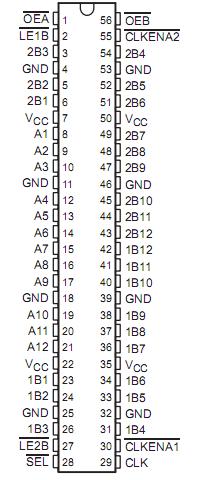
SpecificationsSupply voltage range, VCC (see Note 1) . . . . . . . . . . . . . . . . . . . . . . . 0.3 V to 7 V
Differential bus voltage range (B side) . . . . . . . . . . . . . . . . . . . . . . . . . 10 V to15 V
Single-ended bus voltage range (A side and control inputs) . . . . . . . 0.3 V to 7 V
Continuous total power dissipation (see Note 2) . . . . . . . . . . Internally Limited (see Dissipation Rating Table)
Electrostatic discharge (see Note 3): Class 2 A (all pins) . . . . . . . . 4 kV
Class 2 B (all pins) . . . . . . . . 400 V
Class 3 A (B-side and GND) 12 kV
Class 3 B (B-side and GND) 400 V
Operating free-air temperature range, TA . . . . . . . . . . . . . . . . . . . . . . 0°C to 70°C
Storage temperature range, Tstg . . . . . . . . . . . . . . . . . . . . . . . . . . . . . . 65°C to 150°C
Lead temperature 1,6 mm (1/16 inch) from case for 10 seconds . . 260°C
Stresses beyond those listed under "absolute maximum ratings" may cause permanent damage to the device. These are stress ratings only, and
functional operation of the device at these or any other conditions beyond those indicated under "recommended operating conditions" is not
implied. Exposure to absolute-maximum-rated conditions for extended periods may affect device reliability.
NOTES:
1. All voltage values are with respect to GND.
2. The maximum operating junction temperature is internally limited. Use the dissipation rating table to operate below this temperature.
3. This absolute maximum rating is tested in accordance with MIL-STD-883C, Method 3015.7.DescriptionThe SN75971B SCSI differential converter-data is a 9-channel RS-485 transceiver. When used in conjunction with its companion control transceiver, the SN75970B, the resulting chip set provides the superior electrical performance of differential SCSI from a single-ended SCSI bus or controller. A 16-bit Ultra-SCSI (or Fast-20) SCSI bus can be implemented with just three devices (two data and one control) in the space efficient, 56-pin, shrink small-outline package (SSOP) or thin shink small outline package (TSSOP) and a few external components. An 8-bit SCSI bus requires only one data and one control transceiver
The SN75971B is available in a B2 (20 Mxfer) version and a B1 (10 Mxfer) version.
In a typical differential SCSI node, the SCSI controller provides an enable for each external RS-485 transceiver channel. This could require as many as 27 extra terminals for a 16-bit differential bus controller or relegate a 16-bit, single-ended controller to only an 8-bit differential bus. Using the standard nine SCSIcontrol signals, the SN75970B control transceiver decodes the state of the bus and enables the SN75971B data transceiver to transmit the single-ended SCSI input signals (A side) differentially to the cable or receive the differential cable signals (B side) and drive the single-ended outputs to the controller.
A SN75971B reset function, which disables all outputs and clears internal latches, can be accomplished from two external inputs and two internally-generated signals. ,RESET (reset) and DSENS (differential sense) are available to external circuits for a bus reset or to disable all outputs should a single-ended cable be inadvertently connected to a differential connector. Internally-generated power-up and thermal-shutdown signals have the same affect when the supply voltage is below approximately 3.5 V or the junction temperature exceeds 175°C. Please be aware that an important notice concerning avai .
The SCSI SN75971B , differential, converter-data chip operates in two modes depending on the state of the DRVBUS input.With DRVBUS low, a bidirectional latch circuit sets the direction of data transfer. Each data bit has its own latch, and each bit's direction is independent of all other bits. When neither the single-ended nor the differential sides are asserted, the latch disables both A- and B-side output drivers. When the input to either side is asserted, the latch enables the opposite side's driver and sets data flow from the asserted input to the opposite side of the device. When the input deasserts, the latch maintains the direction until the receiver on the enabled driver detects a deassertion. The latch then returns to the initial state. No parity checking is done by this device SN75971B; the parity signal passes through the device like other data signals do.
When SN75971B DRVBUS is high, direction is determined by the SDB signal. However, a change in SDB does not always immediately change the direction. When DRVBUS first asserts, the direction indicated by SDB is latched and takes effect immediately. When SDB changes while DRVBUS is high, the drivers that were on immediately turn off. However, the other driver set does not turn on until the receivers sense a deasserted state on all nine data lines. This is done to prevent the active drivers from turning on until all other drivers are off and the terminators pull the lines to a deasserted state.
The single-ended SCSI SN75971B bus interface consists of CMOS, bidirectional inputs and outputs. The drivers are rated to ±16 mA of output current. The receiver inputs are pulled high with approximately 4 mA to eliminate the need for external pullup resistors for the open-drain outputs of most single-ended SCSI controllers. The single-ended side of the device is not intended to drive the SCSI bus directly.
The differential SCSI SN75971B bus interface consists of bipolar, bidirectional inputs and outputs that meet or exceed the requirements of EIA-485 and ISO 8482-1982/TIA TR30.2 referenced by American National Standard of Information Systems (ANSI) X3.131-1994 Small Computer System Interface-2 (SCSI-2) and SCSI-3 Fast-20 Parallel Interface (Fast-20) X3.277:1996.

 SN75971B Data Sheet