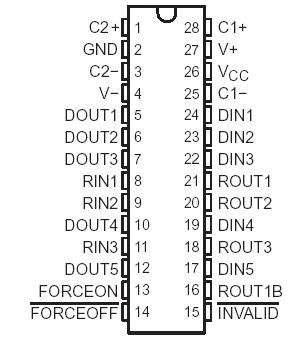
PinoutSpecificationsSupply voltage range, VCC (see Note 1) . . . . . . . . . . . . . . . . . . . . .. . . .−0.3 V to 6 V Positive output supply voltage range, V+ (see Note 1) . . . . . . . . . . .. . .−0.3 V to 7 V Negative output supply voltage range, V− (see Note 1) . . . . . ....
SN75C3238: PinoutSpecificationsSupply voltage range, VCC (see Note 1) . . . . . . . . . . . . . . . . . . . . .. . . .−0.3 V to 6 V Positive output supply voltage range, V+ (see Note 1) . . . . . . . . ....
SeekIC Buyer Protection PLUS - newly updated for 2013!
268 Transactions
All payment methods are secure and covered by SeekIC Buyer Protection PLUS.

The SN75C3238 devices consist of five line drivers, three line receivers, and a dual charge-pump circuit with ±15-kV ESD protection pin to pin (serial-port connection pins, including GND). The charge pump and four small external capacitors allow operation from a single 3-V to 5.5-V supply. In addition, these devices include an always-active noninverting output (ROUT1B), which allows applications using the ring indicator to transmit data while the device is powered down. These devices SN75C3238 operate at data signaling rates up to 1 Mbit/s and at an increased slew-rate range of 24 V/µs to 150 V/µs.
Flexible control options for power management are featured when the serial-port and driver inputs are inactive. The auto-powerdown plus feature functions when FORCEON is low and FORCEOFF is high. During this mode of operation, if the device SN75C3238 does not sense valid signal transitions on all receiver and driver inputs for 30 s, the built-in charge-pump and drivers are powered down, reducing the supply current to 1 µA. By disconnecting the serial port or placing the peripheral drivers off, auto-powerdown plus will occur if there is no activity in the logic levels for the driver inputs. Auto-powerdown plus can be disabled when FORCEON and FORCEOFF are high. With auto-powerdown plus enabled, the device SN75C3238 automatically activates once a valid signal is applied to any receiver or driver input. INVALID is high (valid data) if any receiver input voltage is greater than 2.7 V or less than −2.7 V or has been between −0.3 V and 0.3 V for less than 30 µs. INVALID is low (invalid data) if all receiver input voltages are between −0.3 V and 0.3 V for more than 30 µs. Refer to Figure 5 for receiver input levels.