Features: *Flash Organization: 1M x16
*Dual-Bank Architecture for Concurrent
Read/Write Operation
--16 Mbit: 12 Mbit + 4 Mbit
*SRAM Organization:
--2 Mbit: 256K x8 or 128K x1
--4 Mbit: 512K x8 or 256K x1
*Single 2.7-3.3V Read and Write Operation
*Superior Reliability
--Endurance: 100,000 Cycles (typical)
--Greater than 100 years Data Retention
*Low Power Consumption:
--Active Current: 25 mA (typical)
--Standby Current: 20A (typical)
*Hardware Sector Protection (WP#)
--Protects 4 outer most sectors (4 KWord) in the
larger bank by holding WP# low and unprotects
by holding WP# high
*Hardware Reset Pin (RST#)
--Resets the internal state machine to reading data array
*Sector-Erase Capability
--Uniform 1 KWord sector
*Block-Erase Capability
--Uniform 32 KWord block
*Read Access Time
--Flash: 70 and 90 ns
--SRAM: 70 and 90 ns
*Latched Address and Data
*Fast Erase and Word-Program:
--Sector-Erase Time: 18 ms (typical)
--Block-Erase Time: 18 ms (typical)
--Chip-Erase Time: 70 ms (typical)
--Word-Program Time: 14s (typical)
--Chip Rewrite Time: 8 seconds (typical)
*Automatic Write Timing
--Internal Vpp Generation
*End-of-Write Detection
--Toggle Bit
--Data# Polling
--Ready/Busy# pin
*CMOS I/O Compatibility
*JEDEC Standard Command Set
*Conforms to Common Flash Memory Interface (CFI)
*Packages Available
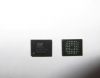
--56-ball LFBGA (8mm x 10mm)
SpecificationsOperating Temperature . . . . .. . . . . . . . . . . . . . . . . . . . . . . . . . . . -20 to +85
Storage Temperature. . . . .. . . . . . . . . . . . . . . . . . . . . . . . . . . . . -65 to +125
D. C. Voltage on Any Pin to Ground Potential . . . . . . . . . .. . . -0.5V to VDD1+0.3V
Transient Voltage (<20 ns) on Any Pin to Ground Potential. . -1.0V to VDD1+1.0V
Package Power Dissipation Capability (Ta = 25) . . . . . . . . . . . . . . . . .. . . .1.0W
Surface Mount Lead Soldering Temperature (3 Seconds). . . . . . . . . . . . .. . .240
Output Short Circuit Current2. . . . . . . . . . . . . . . . . . . . . . . . . . . . . . . . . . . .50 mA
1.VDD = VDDF and VDDS
2.Outputs shorted for no more than one second.
No more than one output shorted at a time. Description
The SST34HF1641 ComboMemory devices integrate a 1M x16 CMOS flash memory bank with a 256K x8/ 128K x16 or 512K x8/ 256K x16 CMOS SRAM memory bank in a Multi-Chip Package (MCP). These devices are fabricated using SST's proprietary, high-performanc CMOS SuperFlash technology incorporating the split-gate cell design and thick oxide tunneling injector to attain better reliability and manufacturability compared with alternate approaches. The SST34HF1621/1641 devices are ideal for applications such as cellular phones, GPSs, PDAs and other portable electronic devices in a low power and small form factor system.
The SST34HF1641 features dual flash memory bank architecture allowing for concurrent operations between the two flash memory banks and the SRAM. The devices can read data from either bank while an Erase or Program operation is in progress in the opposite bank. The two flash memory banks are partitioned into 4 Mbit and 12 Mbit with top or bottom sector protection options for storing boot code, program code, configuration/parameter data and user data.
The SST34HF1641 provides fixed Erase and Pro gram times, independent of the number of Erase/Program cycles that have occurred. Therefore, the system software or hardware does not have to be modified or de-rated as is necessary with alternative flash technologies, whose Erase and Program times increase with accumulated Erase/Program cycles. The SST34HF1621/1641 devices offer a guaranteed endurance of 10,000 cycles. Data retention is rated at greater than 100 years. With high performance Word-Program, the flash memory banks provide a typical Word-Program time of 14 sec. The entire flas memory bank can be erased and programmed word-by-word in typically 8 seconds for the SST34HF1621/1641, when using interface features such as Toggle Bit or Data# Polling to indicate the completion of Program operation. To protect against inadvertent flash write, the SST34HF1621/ 1641 devices contain on-chip hardware and software data protection schemes.
The flash and SRAM operate as two independent memory banks with respective bank enable signals. The memory bank selection is done by two bank enable signals. The SRAM bank enable signal, BES1# and BES2, selects the SRAM bank. The flash memory bank enable signal, BEF#, has to be used with Software Data Protection (SDP) command sequence when controlling the Erase and Program operations in the flash memory bank. The memory banks are superimposed in the same memory address space where they share common address lines, data lines, WE# and OE# which minimize power consumption and area.Bus contention is eliminated as the device will not recognize both bank enables as being simultaneously active.
Designed, manufactured, and tested for applications requiring low power and small form factor, the SST34HF1621/ 1641 are offered in both commercial and extended temperatures and a small footprint package to meet board space constraint requirements.

 SST34HF1641 Data Sheet