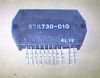
Features: • IMST substrate (insulated metal substrate technology)• Efficiency improved (by 10%) by the adoption of MOSFET and SBD technology.• An auxiliary drive power supply is no longer required due to the development of a unique NMOS FET drive circuit. This means that the STK...
STK730C: Features: • IMST substrate (insulated metal substrate technology)• Efficiency improved (by 10%) by the adoption of MOSFET and SBD technology.• An auxiliary drive power supply is no...
SeekIC Buyer Protection PLUS - newly updated for 2013!
268 Transactions
All payment methods are secure and covered by SeekIC Buyer Protection PLUS.
| Parameter | Symbol |
Rating |
Unit |
| Maximum DC input voltage | Vin (DC) max |
40 |
V |
| Maximum output current | IO max |
5 |
A |
| Thermal resistance | j-c |
3.5 (SBD 7.2) |
/W |
| Junction temperature | Tj max |
150 (SBD 125) |
|
| Storage temperature | Tc max |
105 |
|
| Storage Temperature | Tstg |
30 to +105 |
The STK730C is a chopper type step-down dedicated 5 V single output regulator that uses a power MOSFET as its switching element and a Schottky barrier diode (SBD) as its flywheel diode.
The STK730C covers the 2 A and higher current regions, regions that are difficult to handle with three terminal step-down regulators. As compared with earlier chopper regulator products that used bipolar transistors,the efficiency of the STK730 C has been further improved by the adoption of MOSFET and SBD technologies, and use of the STK730 C enables further miniaturization and increased performance in the end product since it corresponds to the adoption of a dedicated switching controller IC. Furthermore, due to the development of a unique MOS drive circuit, the STK730C can be used with a single power supply input.
The STK730C can prove useful when standardizing and rationalizing power supply circuit design, since it can handle a wide range of power supply circuits in a number of applications, either as the secondary side regulator in a switching power supply or as the output regulator following AC transformer rectification.