Features: 3.3V and 5V power supply options Up to 1GHz clock frequencies Internal quartz reference oscillator driven by quartz crystal or PECL source Low jitter PLL design On-chip 20 ohm driver Differential outputs with 600mV (min) swing Optional pull-down resistors for AC-coupled outputs Low power...
SY89424V: Features: 3.3V and 5V power supply options Up to 1GHz clock frequencies Internal quartz reference oscillator driven by quartz crystal or PECL source Low jitter PLL design On-chip 20 ohm driver Diffe...
SeekIC Buyer Protection PLUS - newly updated for 2013!
268 Transactions
All payment methods are secure and covered by SeekIC Buyer Protection PLUS.

| Symbol | Parameter | Value | Unit |
| VCC | Power Supply Voltage | 0.5 to +7.0 | V |
| VI | TTL Input Voltage(2) | 0.5 to 6.0 | V |
| II | TTL Input Current | 30 to +5.0 | mA |
| IOUT | ECL Output Current - Continuous - Surge |
50 100 |
mA |
| Tstore | Storage Temperature | 65 to +150 | °C |
| TA | Operating Temperature Range | 0 to +75 | °C |
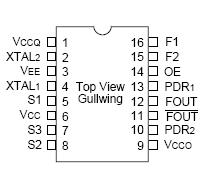
The SY89424V is a low-power Phase Locked Loop (PLL) based frequency synthesizer. The SY89424V is capable of generating up to 1GHz clock frequencies with a low-cost 1025MHz external series-resonant quartz crystal. One can also use PECL differential clock signals to drive this device instead of the quartz crystal. Operation of this chip is controlled by three select pins (S1, S2 and S3). S1 selects the divide ratio of 24 or 50 for the PLL. S2 and S3 select the output frequency. There are two pull-down resistor pins (PDR1 and PDR2). Each pin of SY89424V has an on-chip resistor that will control the output driver currents. When PDR1 and PDR2 pins are open, both outputs are normal open emitter PECL drivers. When PDR1 and PDR2 pins are shorted to the outputs, on-chip pull down currents of 25mA (40mA at 5V VCC) are provided. Both output drivers are capable of driving 20 ohm clock lines. An output enable (OE) pin is available and it can be HIGH or left open for normal operation. When OE is LOW, a built-in Disable Timing Synchronizer will force the FOUT output to LOW at the completion of the HIGH clock cycle. The FOUT output remains HIGH during that time.