PEF20542 Features
Serial communication controllers (SCCs)
• Two independent channels
• Full duplex data rates on each channel of up to
16 Mbit/s sync - 2 Mbit/s with DPLL
• 64 Bytes deep receive FIFO per SCC
• 64 Bytes deep transmit FIFO per SCC
Serial Interface
• On-chip clock generation or external clock sources
• On-chip DPLLs for clock recovery
• Baud rate generator
• Clock gating signals
• Clock gapping capability
• Programmable time-slot capability for connection to
TDM interfaces (e.g. T1, E1)
• NRZ, NRZI, FM and Manchester data encoding
• Optional data flow control using modem control lines (RTS, CTS, CD)
• Support of bus configuration by collision detection and resolution
Bit Processor Functions
• HDLC/SDLC Protocol Modes
Automatic flag detection and transmission
Shared opening and closing flag
Generation of interframe-time fill '1's or flags
Detection of receive line status
Zero bit insertion and deletion
CRC generation and checking (CRC-CCITT or CRC-32)
Transparent CRC option per channel and/or per frame
Programmable Preamble (8 bit) with selectable repetition rate
Error detection (abort, long frame, CRC error, short frames)
• Bit Synchronous PPP Mode
Bit oriented transmission of HDLC frame (flag, data, CRC, flag)
Zero bit insertion/deletion
15 consecutive '1' bits abort sequence
• Octet Synchronous PPP Mode
Octet oriented transmission of HDLC frame (flag, data, CRC, flag)
Programmable character map of 32 hard-wired characters (00H-1FH)
Four programmable characters for additional mapping
Insertion/deletion of control-escape character (7DH) for mapped characters
• Asynchronous PPP Mode
Character oriented transmission of HDLC frame (flag, data, CRC, flag)
Start/stop bit framing of single character
Programmable character map of 32 hard-wired characters (00H-1FH)
Four programmable characters for additional mapping
Insertion/deletion of control-escape character (7DH) for mapped characters
• Asynchronous (ASYNC) Protocol Mode
Selectable character length (5 to 8 bits)
Even, odd, forced or no parity generation/checking
1 or 2 stop bits
Break detection/generation
In-band flow control by XON/XOFF
Immediate character insertion
Termination character detection for end of block identification
Time out detection
Error detection (parity error, framing error)
• BISYNC Protocol Mode
Programmable 6/8 bit SYN pattern (MONOSYNC)
Programmable 12/16 bit SYN pattern (BISYNC)
Selectable character length (5 to 8 bits)
Even, odd, forced or no parity generation/checking
Generation of interframe-time fill '1's or SYN characters
CRC generation (CRC-16 or CRC-CCITT)
Transparent CRC option per channel and/or per frame
Programmable Preamble (8 bit) with selectable repetition rate
Termination character detection for end of block identification
Error detection (parity error, framing error)
• Extended Transparent Mode
Fully bit transparent (no framing, no bit manipulation)
Octet-aligned transmission and reception
• Protocol and Mode Independent
Data bit inversion
Data overflow and underrun detection
Timer
Protocol Support
• Address Recognition Modes
No address recognition (Address Mode 0)
8-bit (high byte) address recognition (Address Mode 1)
8-bit (low byte) or 16-bit (high and low byte) address recognition (Address Mode 2)
• HDLC Automode
8-bit or 16-bit address generation/recognition
Support of LAPB/LAPD
Automatic handling of S- and I-frames
Automatic processing of control byte(s)
Modulo-8 or modulo-128 operation
Programmable time-out and retry conditions
SDLC Normal Response Mode (NRM) operation for slave
• Signaling System #7 (SS7) support
Detection of FISUs, MSUs and LSSUs
Unchanged Fill-In Signaling Units (FISUs) not forwarded
Automatic generation of FISUs in transmit direction (incl. sequence number)
Counting of errored signaling units
Integrated DMA Controller
• 4 independent DMA channels
• Optimized for minimum CPU intervention
• Efficient block-oriented data transfer
• Bus preemption
• Fragmented transmission/reception of data packets from/into multiple buffers
• Switched-Buffer mode for seamless update of buffer base address and size
• 24-bit adressable memory range
• Optional DTACK/READY controlled cycles
Microprocessor Interface
• 8/16-bit bus interface
• De-multiplexed address/data bus
• Intel/Motorola style
• Asynchronous interface
• Maskable interrupts for each channel
General Purpose Port (GPP) Pins
General
• 3.3V power supply with 5V tolerant inputs
• Low power consumption
• Power safe features
• P-TQFP-144-10 Package (Thermal Resistance: RJA = 39K/W)
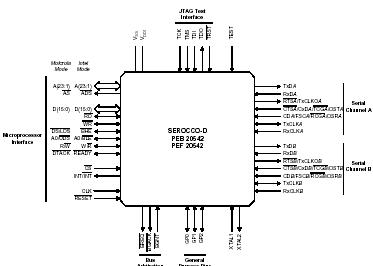
PEF20542 Connection Diagram
Map list: ABCDEFGHIJKLMNOPQRSTUVWXYZ 0123456789All