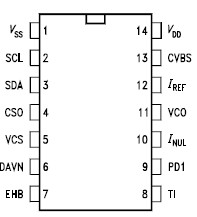
Features: mC suitable VPS data editing direct from CVBS signaln-channel MOSGenerating of the line synchronous 5-MHz clock for the time base and data clock by means of PLL operationVery few external components necessaryAdaptative data separationFrame signal recognitionDecoder for line 16Bi-phase an...
SDA5642X: Features: mC suitable VPS data editing direct from CVBS signaln-channel MOSGenerating of the line synchronous 5-MHz clock for the time base and data clock by means of PLL operationVery few external ...
SeekIC Buyer Protection PLUS - newly updated for 2013!
268 Transactions
All payment methods are secure and covered by SeekIC Buyer Protection PLUS.

| Parameter | Symbol | Limit Values | Unit | Test Conditions | ||
| min. | typ. | max. | ||||
| Ambient temperature | TA | 0 | 70 | in operation | ||
| Storage temperature | Tstg | 40 | 125 | by storage | ||
| Total power dissipation | Ptot | 300 | mW | |||
| Power dissipation per output | PDQ | 10 | mW | |||
| Input voltage | VIM | 0.3 | 6 | V | ||
| Supply voltage | VDO | 0.3 | 6 | V | ||
| Thermal resistance | Rth SU | 80 | K/W | |||
The function of SDA5642X is to regenerate the biphase coded VPS data from the CVBS signal. These data are transferred during line 16, which is part of the vertical blanking time. After decoding and a check for transmission errors, these data can be acquired by a microcontroller for further processing. The function of the SDA5642X is explained in more detail by means of the block diagram.
The CVBS signal (pos. video) from the IF-stage is coupled to the SDA5642X by means of a capacitor. The required level is typically 1 Vpp. Then the signal path is split into two parts:
In the synchronous pulse separator stage the CVBS signal SDA5642X is clamped, filtered and the video signal is clipped away from the synchronization pulses. The output signal of this stage is VCS signal. This is used as the control signal for the line 16 decoder and is also used for the blanking of the color burst. SDA5642X is also used in the regeneration of the internal clock (PLL).
The second signal path of SDA5642X leads to the data slicer. After amplification of the video signal the level is averaged and the slicing level is derived from this signal. The slicing level is equal to one half of the level difference between the minimum and the maximum value of the data signal. SDA5642X assures the optimal slicing of the data from the video signal.
The biphase coded data signal sliced SDA5642X from the video signal and the synchronization pulse signal VCS are used in the clock generator circuit. Based upon a PLL, this circuit generates a clock frequency of 5 MHz from the VCS signal. This clock signal of SDA5642X is synchronized to the line frequency. During line 16 the clock is synchronized to the data signal.
The synchronization of the data clock SDA5642X is controlled by the signal Z 16, which is the output of the decoder for line 16. This decoder is used to detect line 16 from the VCS signal and to control the data acquisition during this time. An indication signal SDA5642X for the first field of a frame is generated by measuring the duration of the VCS signal pulses and the interval between them.
The regenerated data signal and the recovered data clock of SDA5642X are the input signals for a decoding logic which performs the test for the start code and the biphase code. For this purpose the data signal during line 16 is searched for the start bit. This bit, which is used for the synchronization of the decoding logic, is the only bit which does not comply with the biphase format (Manchester code). The detection of the startcode, which is contained in the next six bits following the start bit, SDA5642X is required for the transfer of the correct data into the output register.
Among the 15 bytes (8 bits/byte), which are transferred by the data line 16, only 5 bytes are important for the operation of VPS in the video recorder. These are the 5th and the 11th through the 14th byte. These 40 bits in total are transferred into a serial operating register buffer. The check SDA5642X for the correct transfer of the data according the biphase code is performed during the complete transfer of the data telegram in line 16. After the end of word 14 the relevant bytes are transferred into the transmission register bank. This is done when a microcontroller SDA5642X can read the data from the transmission register bank via the I2C-Bus interface. The SDA5642X can operate on the I2C-Bus as slave-transmitter device. After reading the data, all registers are set to hex "F". Only after the correct reception of data line 16, is the register content updated again.