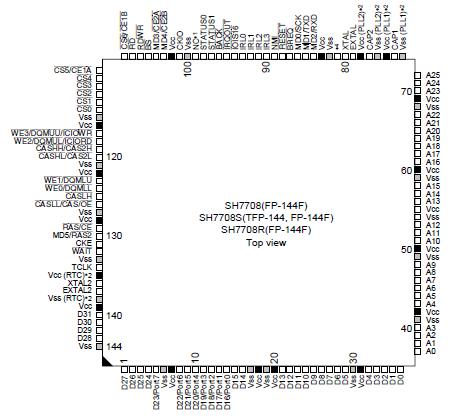
Features: CPU ` Original Hitachi SuperH RISC engine architecture` 32-bit internal data bus` General-register machine- Sixteen 32-bit general registers (eight 32-bit bank registers)- Five 32-bit control registers- Four 32-bit system registers` RISC-type instruction set (upward compatibility with th...
SH7708S: Features: CPU ` Original Hitachi SuperH RISC engine architecture` 32-bit internal data bus` General-register machine- Sixteen 32-bit general registers (eight 32-bit bank registers)- Five 32-bit cont...
SeekIC Buyer Protection PLUS - newly updated for 2013!
268 Transactions
All payment methods are secure and covered by SeekIC Buyer Protection PLUS.
Features: SpecificationsDescription This is the description of SH7708 Series: The SH7708, SH7708S,...

|
Item |
Symbol |
Ratings |
Units |
| Power supply voltage |
VCC |
0.3 to 4.6 |
V |
| Input voltage |
Vin |
0.3 to VCC + 0.3 |
V |
| Operating temperature |
Topr |
20 to 75 |
°C |
| Storage temperature |
Tstg |
55 to 125 |
°C |
There are five SH7708S registers for MMU processing. These SH7708S are all peripheral module registers, so they are located in address space area P4 and can only be accessed from privileged mode by specifying the address. These SH7708S registers consist of:
1. The page table entry register high (PTEH) register residing at address H'FFFFFFF0, which consists of a virtual page number (VPN) and ASID. The VPN set is the VPN of the virtual address at which the exception is generated in the case of an MMU exception or address error exception. When the page size is 4 kbytes, the VPN is the upper 20 bits of the virtual address, but in this case the upper 22 bits of the virtual address are set. The VPN can also be modified by software. As the ASID, software sets the number of the currently executing process. The VPN and ASID are recorded in the TLB by the LDTLB instruction.
2. The page table entry register low (PTEL) register residing at address H'FFFFFFF4, and used to store the physical page number and page management information to be recorded in the TLB by the LDTLB instruction. The contents of this register are only modified in response to a software command.
3. The translation table base register (TTB) residing at address H'FFFFFFF8, which points to the base address of the current page table. The hardware does not set any value in TTB automatically. TTB is available to software for general purposes.
4. The TLB exception address register (TEA) register residing at address H'FFFFFFFC, which stores the virtual address corresponding to a TLB or address error exception. This value remains valid until the next exception or interrupt.
5. The MMU control register (MMUCR) residing at address H'FFFFFFF0, which makes the MMU settings described in figure 3.3. Any program that modifies MMUCR should reside in the P1 or P2 area.