Features: ` State-of-the-Art EPIC-II BE BiCMOS Design Significantly Reduces Power Dissipation` ESD Protection Exceeds 2000 V Per MIL-STD-883, Method 3015; Exceeds 200 V Using Machine Model (C = 200 pF, R = 0)` Latch-Up Performance Exceeds 500 mA Per JESD 17` Typical VOLP (Output Ground Bounce) <...
SN54ABT853: Features: ` State-of-the-Art EPIC-II BE BiCMOS Design Significantly Reduces Power Dissipation` ESD Protection Exceeds 2000 V Per MIL-STD-883, Method 3015; Exceeds 200 V Using Machine Model (C = 200 ...
SeekIC Buyer Protection PLUS - newly updated for 2013!
268 Transactions
All payment methods are secure and covered by SeekIC Buyer Protection PLUS.
Features: PinoutSpecificationsDescriptionThe SN54/74LS147 and SN54/74LS148 are Priority Encoders. ...
PinoutDescriptionThe LS155 and LS156 are Dual 1-of-4 Decoder/Demultiplexers with common Address in...

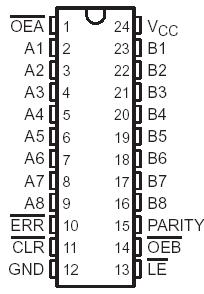
The SN54ABT853 8-bit to 9-bit parity transceivers are designed for communication between data buses. When data is transmitted from the A bus to the B bus, a parity bit is generated. When data is transmitted from the B bus to the A bus with its corresponding parity bit, the open-collector parity-error (ERR) output indicates whether or not an error in the B data has occurred. The output-enable (OEA and OEB) inputs can be used to disable the device so that the buses are effectively isolated. The SN54ABT853 transceivers provide true data at their outputs.
A 9-bit parity generator/checker of SN54ABT853 generates a parity-odd (PARITY) output and monitors the parity of the I/O ports with the ERR flag. The parity-error output can be passed, sampled, stored, or cleared from the latch using the latch-enable (LE) and clear (CLR) control inputs. When both OEA and OEB are low, data is transferred from the A bus to the B bus and inverted parity is generated. Inverted parity of SN54ABT853 is a forced error condition that gives the designer more system diagnostic capability.
When VCC is between 0 and 2.1 V, the SN54ABT853 is in the high-impedance state during power up or power down. However, to ensure the high-impedance state above 2.1 V, OE should be tied to VCC through a pullup resistor; the minimum value of the resistor SN54ABT853 is determined by the current-sinking capability of the driver.