Features: • Single chip solution:
AD-conversion for CVBS or Y/C or YUV1), multistandard color decoding, PLL for
synchronization of inset channel, decimation filtering, embedded memory, RGBmatrix,
DA-conversion, RGB/YUV switch, data-slicer and clock generation
integrated on chip
• Analog inputs:
3x CVBS or 1x CVBS and 1x Y/C or 1xYUV 1)alternatively
Clamping of each input
All ADCs with 8 bit amplitude resolution
Automatic Gain Control (AGC) for Y and CVBS
• Inset Synchronization:
Multiple time constants for reliable synchronization
Automatic recognition of 625 lines / 525 lines standard
• Color Decoder:
PAL-B/G, PAL-M, PAL-N(Argentina), PAL60, NTSC-M, NTSC4.4 and SECAM
Adjustable color saturation
Hue control for NTSC
Automatic Chroma Control (-24 dB ... +6 dB)
Automatic recognition of chroma standards: different search strategies selectable
Single crystal for all standards
IF-characteristic compensation filter
• Decimation:
PIP sizes between 1/81 and 1/4 adjustable with steps of 2 lines and 4 pixel
Resolution up to 324 luminance and 2x81 chrominance pixels per inset line
Horizontal and vertical filtering dependent on picture size
Automatic zoom in/out possible with three speeds
• Display Features:
7 bit per pixel stored in memory
Field and joint-line free frame mode display (even at 100/120 Hz AABB with picture
sizes<=1/9)
Two 'split-screen' modes with horizontal decimation of 2 and vertical of 1.5 or 1.0
POP display
Up to 12 pictures of 1/36th size (11 still and 1 moving)
Up to 6 pictures of 1/16th size (5 still and 1 moving)
Up to 3 pictures of 1/9th size (2 still and 1 moving)
Display on VGA and SVGA screen (fH limited to 40kHz)
8 different read frequencies for 16:9 compatibility
Line doubling mode for progressive scan applications
Freeze picture
Coarse positioning at 4 corners of the parent picture
Fine positioning at steps of 4 pixels and 2 lines
Wipe in / out programmable with 3 time periods
• Output signal processing:
7 Bit DAC
RGB or YUV switch: insertion of an external source without PIP processing
Digital interpolation for anti-imaging
Adjustable transient improvement for luma (peaking)
Contrast, Brightness and Pedestal Level adjustable
Analog outputs: Y, +(B-Y), +(R-Y), or Y, -(B-Y), -(R-Y) or RGB
Three RGB matrices available: NTSC(Japan), NTSC(USA) or EBU
64 different background colors and 4096 different frame colors
Plain or 3D frame with variable width and height
• Data Slicing:
Slicing of closed-caption (CC) or wide-screen-signaling (WSS) data
Violence blocking capability (V-chip)
Several filter for XDS data extraction
• On-screen display:
64 characters programmable
5 characters displayed in every PIP picture or 3 rows of 20 characters each
4 different character luminance values or frame color
4 background luminance values or (semi-) transparent mode
• I2C-Bus control (400 kHz)
• High stability clock generation
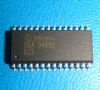
• PDSO 28-1 package (SMD)
• Full SDA 9488X and SDA 9588X backward compatibility
• SDA 9388X / SDA 9389X pinout compatibility
• 3.3V supply voltage (5V input capable)
ApplicationThe following two figures show 100/120Hz applications with the Micronas Featurebox SDA 9400/01. As the chip supports two I2C addresses and owns a RGB switch dual-PiP applications are easy to implement. The arrangement for best possible performance is shown in the fig. (5-1).
Figure 5-1 SDA 9589X application with insertion in front of the featurebox
The output of two 'SOPHISTICUS' are connected to the YUV (or RGB) input of the video processor of the main channel. Due to the 4:2:2 processing within the SDA 9400 the inset picture remains brilliant.
Figure 5-2 SDA 9589X application with insertion behind the featurebox
Connecting the SDA 9589X/SDA 9489X directly to the RGB input of the RGB processor is possible as well. One picture is generated from SDA 9589X/SDA 9489X device, the other one from the featurebox. This cheap implementation preserves the chroma of inset channel at its full bandwidth, although frame mode is only possible for PiP pictures
smaller than 1/9. The output of an OSD/Text processor may be fed to the RGB switch of the SDA 9589X/SDA 9489X.
Pinout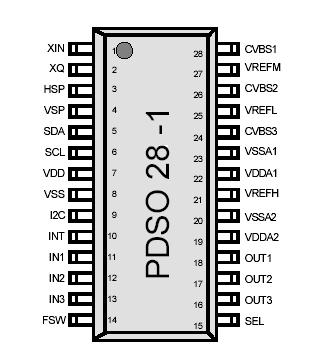 Specifications
| Parameter |
Symbol |
Limit Values |
Unit |
Remark |
| min. |
max. |
| Ambient temperature |
TA |
0 |
70 |
°C |
|
| Storage temperature |
Tstg |
-55 |
125 |
°C |
|
| Junction temperature |
Tj |
|
125 |
°C |
|
| Soldering temperature |
TSOLD |
|
260 |
°C |
duration <10s |
| Input voltage |
Vi |
-0.3V |
VDD + 0.3 V |
1 |
except SDA, SCL,
HSP, VSP |
| Vi |
-0.3 |
5.5 |
V |
SDA, SCL, HSP,
VSP only |
| Output voltage |
VQ |
-0.3V |
VDD + 0.3 V |
1 |
except SDA |
| VQ |
-0.3 |
5.5 |
V |
SDA only |
| Supply voltages |
VDD |
-0.3 |
3.6 |
V |
|
| Supply voltage differentials |
|
0.25 |
0.25 |
V |
|
| Total power dissipation |
Ptot |
|
0.85 |
W |
|
| Latch-up protection |
ILU |
-100 |
100 |
mA |
|
| ESD robustness |
|
-2000 |
2000 |
V |
HBM: 1.5k, 100pF |

 SDA9489X Data Sheet